





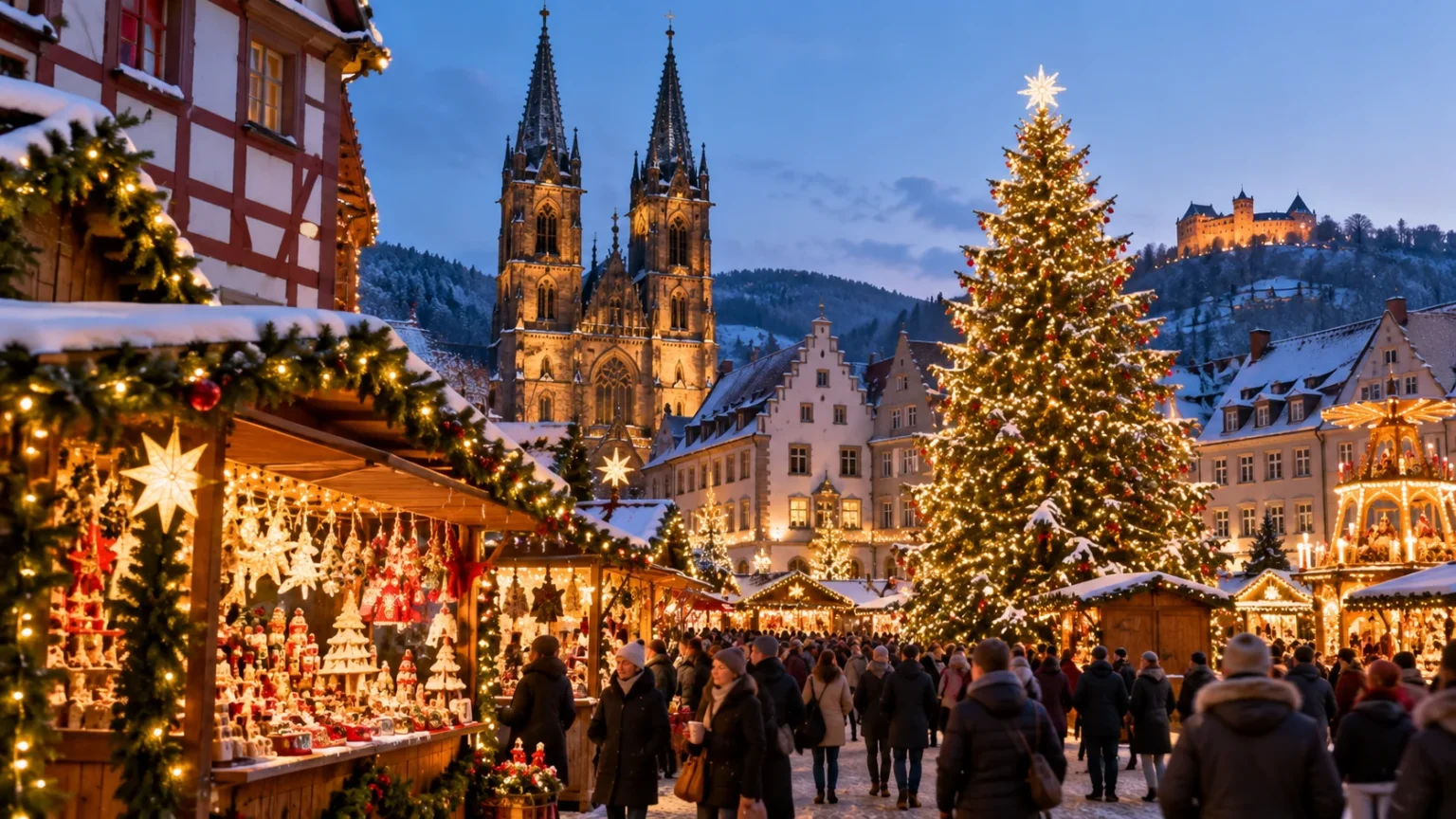
Christmas in Germany: Best Markets, Cities & Traditions
Christmas in Germany feels as if many of the traditions associated with the holiday season have stepped directly into real life. Historic town squares glow beneath thousands of lights, wooden stalls sell handcrafted ornaments and warming food, church towers rise above decorated streets, and the aromas of cinnamon, roasted almonds, gingerbread, and mulled wine drift through the cold air. From famous Christmas markets in Nuremberg and Dresden to romantic celebrations in Rothenburg ob der Tauber, Cologne, Munich, and Berlin, Germany offers countless ways to experience Advent. Each destination has its own character, regional foods, decorations, and customs. For travelers who love winter atmosphere, few European trips feel as festive as Christmas in Germany.
The Christmas season is about much more than markets, however. German families observe Advent with wreaths and calendars, children celebrate St. Nicholas Day, homes are decorated with Christmas trees, and regional traditions vary between northern and southern Germany. Most Christmas markets begin in late November and operate through the weeks of Advent, although many traditional markets close on or shortly before Christmas Eve. Germany’s official tourism information notes that Advent markets commonly begin opening toward the end of November, while December 24 is traditionally an important family celebration. Good planning is therefore essential if markets are the main purpose of your trip. This guide covers Germany’s best Christmas markets, cities, foods, traditions, weather, transportation, and practical tips for creating an unforgettable festive itinerary.
Why Spend Christmas in Germany?
Germany offers one of Europe’s richest Christmas-market cultures, with festive markets appearing in major cities, medieval towns, palace courtyards, and neighborhood squares. A typical Weihnachtsmarkt combines decorated wooden stalls with regional food, warm drinks, handmade gifts, music, and seasonal traditions. Although markets have spread around the world, experiencing them among historic German architecture creates a distinctive atmosphere. Gothic churches, half-timbered houses, Baroque squares, and medieval walls provide natural settings that modern reproductions cannot easily match. Each city adds its own history and local customs, so visiting several markets rarely feels repetitive. For many travelers, simply walking through illuminated streets after dark becomes one of the highlights of the journey.
The diversity between destinations is another major reason to visit. Nuremberg is associated with one of Germany’s most famous traditional markets, while Dresden is renowned for its long-running Striezelmarkt. Cologne surrounds visitors with markets beneath its enormous cathedral, Munich combines Bavarian Christmas traditions with elegant city streets, and Berlin offers multiple markets ranging from classic to contemporary. Smaller destinations such as Rothenburg ob der Tauber can feel particularly romantic because medieval architecture dominates the experience. Travelers can therefore choose between large-city energy and intimate old-town charm. Combining both creates a particularly varied German Christmas itinerary.
German Christmas travel also offers an opportunity to experience winter foods that feel inseparable from the season. Bratwurst sizzling over grills, roasted almonds coated with sugar, gingerbread, Stollen, potato pancakes, sausages, soups, and baked sweets provide plenty of reasons to arrive hungry. Glühwein, the famous German mulled wine, is served hot with warming spices and is one of the defining drinks of Christmas-market culture. Nonalcoholic Kinderpunsch is widely associated with the season as well. Foods differ across regions, giving travelers another reason to visit multiple cities. Christmas markets become as much a culinary experience as a shopping destination.
The country is also relatively easy to explore without renting a car. Germany’s rail network connects major Christmas destinations such as Berlin, Dresden, Nuremberg, Munich, Cologne, Frankfurt, and Hamburg, while regional trains reach many smaller towns. Staying near a central railway station can make two-city or multi-city itineraries considerably simpler. Christmas markets are usually concentrated in historic centers that are comfortable to explore on foot. Public transportation provides additional flexibility in larger cities. This means travelers can enjoy seasonal drinks without worrying about driving afterward.
Finally, Christmas in Germany offers traditions beyond tourism. Advent wreaths, Advent calendars, St. Nicholas Day, decorated Christmas trees, church services, family gatherings, and regional customs remain meaningful parts of the season. Germany’s national tourism organization describes Advent as a period extending across the four weeks before Christmas and highlights traditions including the four-candle Advent wreath and 24-door Advent calendar. Understanding these customs adds depth to a market trip. Instead of seeing decorated stalls as isolated attractions, visitors begin to understand how they connect with the wider German Christmas season.
Nuremberg Christkindlesmarkt
Nuremberg is often one of the first cities travelers consider when planning Christmas in Germany. Its Christkindlesmarkt fills the Hauptmarkt in the heart of the old town with rows of traditional stalls beneath the towers of the Frauenkirche. Red-and-white striped roofs create the recognizable market appearance seen in countless winter photographs. The surrounding medieval cityscape adds to the atmosphere, particularly after sunset. Rather than focusing entirely on modern entertainment, the market maintains a strong association with traditional crafts, seasonal foods, and Nuremberg’s distinctive Christmas identity. First-time visitors who want a classic German Christmas-market experience will find Nuremberg difficult to overlook.
For the 2026 season, Nuremberg’s official tourism and municipal information lists the Christkindlesmarkt from November 27 through December 24, with regular hours generally running from 10 a.m. to 10 p.m. and reduced hours on Christmas Eve. This illustrates an important planning lesson for Germany: do not assume famous traditional markets continue after December 24. Travelers arriving between Christmas Day and New Year’s Eve can discover that some of the markets they intended to visit have already closed. Anyone building a market-focused itinerary should verify exact dates for the year of travel before booking flights and hotels.
Food is an essential part of the Nuremberg experience. Nürnberger Rostbratwürste are small grilled sausages traditionally served in multiples, often inside a bread roll or alongside accompaniments. Nürnberg Lebkuchen, the city’s famous gingerbread, provides another seasonal specialty worth trying. Market stalls also offer roasted nuts, sweets, hot drinks, and other winter foods. Instead of eating a large restaurant meal before visiting, consider treating the market as an informal progressive dinner. Sampling several small items makes the experience more varied and leaves room for regional specialties.
The Christkind plays an important ceremonial role in Nuremberg’s Christmas tradition. The market formally opens with a prologue delivered by the Christkind from the balcony of the Frauenkirche. Germany’s official tourism information highlights this opening tradition as one of the defining features of the Nuremberg market. Visitors who arrive later in the season will not see the opening ceremony, but the Christkind imagery remains part of the market’s identity. Families can also explore Christmas activities designed for children in nearby areas. This makes Nuremberg attractive for both couples and family trips.
Allow at least one overnight stay instead of treating Nuremberg as a rushed afternoon stop. During daylight, explore the old town, castle area, churches, bridges, and historic streets before returning to the market after dark. The transformation between daytime and nighttime is part of the experience. Staying overnight also lets you visit early the next morning when central streets may feel calmer. Nuremberg combines particularly well with Munich, Rothenburg ob der Tauber, Bamberg, or Regensburg in a Bavaria-focused Christmas itinerary. Two nights provide enough time to experience the city without turning every hour into a schedule.
Dresden Striezelmarkt
Dresden is another essential destination for travelers interested in the history of German Christmas markets. Its Striezelmarkt dates to 1434 and is widely presented as Germany’s oldest Christmas market. Germany’s national tourism information specifically identifies Dresden’s Striezelmarkt as dating from that year. The market’s setting in the historic Saxon capital adds considerable appeal because visitors can combine Christmas atmosphere with impressive Baroque architecture, museums, churches, and the rebuilt old city. Dresden is therefore an excellent choice for travelers who want substantial sightseeing in addition to festive activities.
The word Striezel is connected to the traditional Christmas bread now widely known as Dresdner Stollen. This dense festive loaf contains dried fruit and is often dusted generously with powdered sugar. Trying Stollen in Dresden provides more cultural context than buying a generic version elsewhere. Christmas stalls also sell gingerbread, roasted nuts, sausages, sweets, and hot drinks. Saxony has particularly strong associations with traditional Christmas craftsmanship. Wooden decorations, candle arches, nutcrackers, and carved figures linked to the Erzgebirge region are popular seasonal items.
Dresden’s Christmas atmosphere extends beyond one market square. During Advent, different parts of the city typically host markets and festive displays with varied themes. This gives travelers the opportunity to walk between locations rather than spending the entire visit in one crowded area. The old town provides the most dramatic architecture, while areas across the Elbe can offer a different atmosphere. Evening walks along the river can also provide excellent views toward Dresden’s skyline. Cold weather makes the return to a warm café particularly satisfying.
The wider Saxony region adds depth to a Dresden trip. Mining traditions have influenced Christmas customs in the Erzgebirge, where wooden candle arches, pyramids, angels, miners, and carved figures became deeply connected with winter celebrations. Germany’s tourism organization notes that traditional miners’ processions remain part of Advent customs in Saxony. Travelers interested in handcrafted decorations may therefore find Dresden especially rewarding. A day trip toward smaller Saxon towns can complement the larger city experience if time permits. However, Dresden itself easily justifies two or three nights.
Dresden also pairs naturally with Berlin because direct rail travel makes combining the cities relatively straightforward. One itinerary could begin with cosmopolitan Berlin, continue to Dresden for traditional Saxon Christmas atmosphere, and then move toward Nuremberg or Munich. This provides significant architectural and cultural contrast without excessive travel distances. Visitors should book accommodation well in advance for popular Advent weekends. Staying within walking distance of the historic center can make evening market visits much easier. Dresden rewards travelers who combine Christmas festivities with normal city exploration rather than visiting only after dark.
Cologne Christmas Markets
Cologne offers a completely different Christmas experience because its markets unfold around one of Europe’s most recognizable Gothic landmarks. Cologne Cathedral towers over the city center and creates an extraordinary background for festive lights and stalls. Travelers arriving by train receive an especially dramatic introduction because Köln Hauptbahnhof stands immediately beside the cathedral. From there, several central Christmas-market areas can typically be reached on foot. Cologne therefore works exceptionally well for travelers using public transportation. The combination of monumental architecture and concentrated city-center attractions makes short visits easy to organize.
The market near Cologne Cathedral is usually the most famous, but limiting yourself to one location would miss much of the city’s Advent atmosphere. Cologne traditionally hosts multiple Christmas markets with different decorations, themes, foods, and settings. Walking between them allows travelers to experience neighborhoods beyond the cathedral square. The old town near the Rhine adds cobbled streets and historic architecture, while other areas provide more contemporary city energy. This variety makes Cologne particularly suitable for visitors who enjoy exploring several markets in one destination. Two evenings can feel completely different depending on the route you choose.
Food and drink provide another reason to slow down. In addition to familiar Christmas-market snacks, Cologne gives visitors the chance to experience local beer culture. Kölsch is the city’s signature beer and is traditionally served in narrow glasses at local brewhouses. A winter itinerary can therefore alternate between outdoor markets and warm Brauhäuser. This is especially useful on wet or windy evenings when spending five continuous hours outside becomes uncomfortable. Traditional German winter travel is far more enjoyable when indoor breaks are built into the schedule.
Cologne also works well as a base for exploring western Germany. Aachen has a popular Christmas atmosphere around its cathedral and old town, while Düsseldorf and Bonn are easily accessible by train. Travelers could therefore stay several nights in Cologne and make selected day trips rather than moving hotels every night. This reduces luggage handling during a season when trains and stations can be busy. Cologne Bonn Airport also provides useful international connections. For travelers entering Germany from Belgium or the Netherlands, Cologne can be a logical first stop.
The city appeals particularly strongly to travelers who want festive atmosphere without sacrificing nightlife, museums, shopping, and urban energy. Nuremberg may feel more traditionally Christmas-focused, while Cologne offers a broader city break that happens to become intensely festive during Advent. This difference is useful when planning a longer trip. Combining contrasting destinations prevents market fatigue. A journey including Cologne, a medieval smaller town, and one southern German city can provide a more complete picture of Christmas in Germany.
Munich Christmas Markets and Bavarian Traditions
Munich combines a large European city with deeply rooted Bavarian traditions, making it one of the most versatile places to experience Christmas in Germany. The historic center around Marienplatz becomes particularly atmospheric during Advent as lights illuminate the Neues Rathaus and surrounding streets. Munich’s central Christkindlmarkt provides the classic experience of decorated stalls, seasonal food, crafts, and hot drinks. Yet the city is large enough to support numerous additional festive locations. Visitors can explore different neighborhoods and market styles without leaving Munich. This makes it ideal for a three- or four-night Christmas city break.
Bavarian food adds considerable appeal during winter. Sausages, pretzels, roast meats, potato dishes, soups, cheese specialties, and pastries provide plenty of substantial options for cold days. Christmas markets add roasted nuts, sweets, gingerbread, and Glühwein to the mix. Beer halls offer warm indoor alternatives when temperatures drop or rain begins. Rather than spending the entire day outside, alternate sightseeing with long café or restaurant stops. German winter travel becomes much more comfortable when warmth is treated as part of the itinerary rather than an inconvenience.
Munich is also an excellent base for day trips. Salzburg lies across the border in Austria and can be reached conveniently by train, allowing travelers to compare German and Austrian Advent traditions. Bavarian destinations such as Regensburg, Augsburg, and smaller towns may also offer attractive seasonal markets. Neuschwanstein Castle is another popular excursion, although winter weather and daylight should be considered carefully. Travelers primarily interested in Christmas markets may find smaller Bavarian cities more rewarding than packing every famous landmark into one visit. The region offers enough variety for an entire week-long festive itinerary.
Christmas traditions in southern Germany can differ subtly from northern parts of the country. Germany’s tourism organization notes that the Christkind is traditionally more associated with gift-giving in southern regions, while Father Christmas is more established in the north. Regional distinctions are not absolute, but they illustrate how German Christmas culture varies from place to place. Nativity scenes, church music, local crafts, and Bavarian food add further character. Learning a little about these traditions helps travelers understand what they are seeing beyond decorative lights.
Munich can become busy and expensive during popular December weekends, so early accommodation booking is advisable. Staying near the Altstadt provides walking convenience, while neighborhoods near U-Bahn and S-Bahn stations can offer better value without sacrificing accessibility. Do not worry about being directly beside Marienplatz if the price difference is substantial. Munich’s public transportation makes central areas easy to reach. Spend at least one evening exploring beyond the main square, because smaller markets can sometimes provide the more memorable experience.
Rothenburg ob der Tauber at Christmas
Rothenburg ob der Tauber is one of Germany’s most visually romantic destinations at any time of year, and Christmas enhances its medieval atmosphere considerably. Fortified walls, towers, half-timbered buildings, cobbled lanes, and historic squares create the kind of setting many travelers imagine when picturing a traditional German town. Festive decorations add warmth to streets that are already highly photogenic. Compared with Berlin, Cologne, or Munich, Rothenburg feels much smaller and more intimate. This makes it an ideal contrast within a multi-city Christmas itinerary. The town is particularly appealing to couples, photographers, and travelers interested in medieval architecture.
Rothenburg’s seasonal market is often associated with the Reiterlesmarkt tradition. Rather than overwhelming visitors with hundreds of attractions, the experience fits naturally into the compact old town. Stalls, food, lights, and Christmas decorations appear among buildings that already look theatrical. Evening is especially atmospheric after many day-trippers have begun leaving. Staying overnight therefore changes the experience considerably. Early morning provides another opportunity to walk nearly empty streets before tour groups arrive.
The town is also strongly associated with Christmas shopping throughout the year because of its famous Christmas-themed stores and decorative traditions. Visitors interested in ornaments, wooden decorations, candle holders, nutcrackers, or collectible seasonal pieces may find more choice here than expected from such a small destination. However, prices can vary considerably between handcrafted goods and mass-produced souvenirs. Look closely at origin and craftsmanship when buying something intended as a meaningful German keepsake. Smaller artisan products can often feel more distinctive than large decorative items. Packing space should also be considered before purchasing fragile ornaments.
Rothenburg is less convenient by train than major cities because journeys may involve regional connections. This is one reason travelers should consider staying overnight rather than attempting a very short day trip from far away. The town combines especially well with Nuremberg or Würzburg in a broader Franconian itinerary. Driving can provide flexibility, but winter conditions and parking should be considered. Travelers relying on rail should leave reasonable transfer time between regional services. The extra effort is rewarded by a townscape unlike Germany’s larger Christmas destinations.
One full day and one night can provide a satisfying introduction, while two nights allow more relaxed exploration of the walls, churches, museums, shops, and surrounding streets. Do not spend the entire visit inside Christmas stores. Walking the fortifications and looking across the rooftops gives important context to Rothenburg’s medieval character. If snow happens to fall, the town can look extraordinary, but travelers should never plan a German Christmas trip assuming guaranteed snow. Cold rain is equally possible. Rothenburg remains atmospheric regardless because its architecture provides the visual foundation.
Berlin at Christmas
Berlin offers the greatest variety for travelers who prefer a contemporary capital alongside Christmas traditions. Instead of one dominant market, the city typically hosts numerous festive markets spread across different neighborhoods and public spaces. Some emphasize crafts and traditional atmosphere, while others feel modern, international, family-oriented, or entertainment-focused. This variety means visitors can choose experiences according to taste rather than following one obligatory route. Berlin’s museums, historical sites, nightlife, restaurants, and shopping also continue to provide endless alternatives during the day. Christmas therefore becomes one layer of a much larger city break.
The city works particularly well for travelers who might become tired of traditional Christmas markets after several days. Spend the morning visiting Museum Island, Brandenburg Gate, the Reichstag area, or Cold War sites, then dedicate late afternoon and evening to festive markets. This rhythm keeps the trip varied. Berlin’s extensive U-Bahn, S-Bahn, tram, and bus networks make moving between neighborhoods relatively easy. Because markets can be geographically dispersed, clustering attractions by area helps avoid unnecessary transit. Comfortable footwear remains essential despite the public transport.
Berlin’s food scene is another major advantage. Christmas-market classics such as sausages, roasted nuts, sweets, and Glühwein are widely available, but the city also offers one of Germany’s most international restaurant landscapes. Travelers can alternate traditional German meals with Turkish, Vietnamese, Middle Eastern, Italian, and contemporary European cuisine. Currywurst remains a classic Berlin snack regardless of season. This variety is particularly valuable during longer trips when repeated market food starts feeling heavy. A festive vacation does not need every meal to involve sausage and mulled wine.
Accommodation options range from luxury hotels around central landmarks to simpler properties in residential neighborhoods. Staying near a major S-Bahn or U-Bahn station can be more important than being within walking distance of one particular market. Berlin is physically large, and even central attractions can be separated by significant distances. First-time visitors often underestimate how much transport is involved. Choose a neighborhood based on your broader sightseeing plans rather than only Christmas activities. Mitte provides convenience, while other districts can offer more local nightlife or better value.
Berlin also fits naturally at the beginning or end of a German Christmas itinerary because of its extensive rail and international flight connections. Dresden can be combined relatively easily for a contrasting market experience, while longer train journeys connect Berlin with Hamburg, Cologne, Nuremberg, and Munich. If you have only four days in Germany and prioritize traditional Christmas imagery, another city may be more concentrated. If you want Christmas combined with history, culture, restaurants, and nightlife, Berlin becomes one of the strongest choices. Its scale allows different travelers to create completely different festive trips.
Other Beautiful German Cities for Christmas
Hamburg provides a northern German Christmas experience centered around grand architecture, waterways, shopping streets, and several seasonal markets. The maritime character distinguishes it from Bavaria and Saxony. Cold wind can make Hamburg feel particularly wintry, so warm outerwear is essential. Visitors can combine Christmas markets with Speicherstadt, HafenCity, the harbor, and the city’s museums. Cafes and restaurants provide frequent indoor breaks. Hamburg works especially well for travelers who enjoy large cities but want something different from Berlin.
Frankfurt is often overlooked as a Christmas destination because many travelers primarily know it as an airport and financial center. Its historic Römerberg square, however, creates an attractive setting for seasonal festivities. The city’s transport connections make it exceptionally convenient for international visitors and for combining several German destinations by rail. Frankfurt can also serve as a base for nearby towns. Travelers arriving on a morning flight may be able to experience their first Christmas market the same evening. This convenience can make Frankfurt more appealing than its business reputation suggests.
Heidelberg combines a romantic old town, castle views, university atmosphere, and multiple festive areas. Its long pedestrian streets make Christmas shopping easy, while the castle creates a dramatic background above the town. Heidelberg is smaller and calmer than Munich or Berlin but provides more conventional sightseeing than some tiny medieval towns. It combines naturally with Frankfurt or other destinations in southwestern Germany. Visitors interested in architecture and scenic walks may find it particularly rewarding. Staying overnight allows the illuminated old town to be enjoyed after day visitors depart.
Regensburg is an excellent choice for travelers building a Bavarian Christmas itinerary. Its medieval center, stone bridge, cathedral, narrow lanes, and historic buildings provide a beautiful winter setting. The city feels substantial enough for several attractions but compact enough to explore comfortably on foot. It can be reached by train from Munich or Nuremberg, making it useful as either a day trip or overnight destination. Smaller festive markets in historic settings may appeal to travelers who find famous markets too crowded. Regensburg can provide much of the atmosphere with a different pace.
Aachen, Bremen, Lübeck, Erfurt, Leipzig, Stuttgart, and Goslar are among many other destinations that can create excellent Christmas trips. The best city is not necessarily the one with the largest market. Architecture, regional food, transport convenience, crowd tolerance, and nearby destinations should all influence the decision. Travelers with a week should generally choose three bases rather than racing through six or seven cities. Germany’s Christmas atmosphere becomes more enjoyable when evenings can be spent wandering without worrying about catching the last train. Quality of experience usually matters more than number of markets visited.
German Christmas Traditions to Experience
Advent begins the emotional buildup to Christmas and is central to understanding the German festive season. Many homes use an Advent wreath decorated with four candles, with another candle traditionally lit on each Sunday leading toward Christmas. Germany’s national tourism organization traces the German Advent-wreath tradition back nearly two centuries and notes the modern four-candle custom. Churches, homes, restaurants, and public spaces often incorporate similar decorations. Visitors traveling in early December therefore experience Christmas as a gradual season rather than a single holiday. The anticipation is part of the tradition.
Advent calendars are another familiar custom with strong German associations. Traditionally, the calendar contains 24 doors, packages, or compartments, with one opened each day from December 1 through Christmas Eve. Modern versions contain everything from chocolate and toys to cosmetics or specialty foods. Handmade calendars remain popular in families as well. Germany’s tourism organization describes them as an established part of the festive season for both children and many adults. Travelers will see Advent calendars sold in shops and markets throughout December.
St. Nicholas Day, celebrated on December 6, is another important tradition. On the previous evening, children traditionally place cleaned shoes or boots outside so St. Nicholas can leave small treats. Nuts, mandarins, sweets, and small gifts are commonly associated with the custom. Germany’s official tourism information notes that the tradition remains widely enjoyed and is linked to Saint Nicholas of Myra. Visitors arriving around December 5 or 6 may therefore encounter celebrations distinct from Christmas Eve itself. St. Nicholas should not simply be viewed as another name for Santa Claus because the traditions have different origins.
Christmas Eve, or Heiligabend, is often the central family celebration. Gifts are commonly exchanged on December 24 rather than waiting until the morning of December 25 as in some other countries. The Christmas tree becomes a focal point of the home, and some families attend church services later in the evening. Germany’s tourism organization notes regional differences in whether gifts are associated with the Christkind or Weihnachtsmann. Travelers should understand that December 24 can become very quiet outside tourist areas as businesses close and families gather privately.
Christmas Day and December 26 are public holidays, and many businesses are closed or operate limited hours. This changes the rhythm of a trip significantly after the markets and shopping rush of Advent. Travelers staying through Christmas should plan meals and activities ahead rather than assuming normal sightseeing schedules continue. Hotels and selected restaurants may offer festive meals, but reservations can be necessary. Churches and outdoor walks can provide meaningful experiences when commercial attractions close. Spending Christmas itself in Germany can be wonderful, but it requires different planning from a market-focused early-December trip.
German Christmas Foods and Drinks to Try
Glühwein is perhaps the most recognizable Christmas-market drink in Germany. Red wine is warmed with spices and citrus, creating a sweet, aromatic beverage particularly suited to cold evenings. Variations differ between vendors and regions, and white-wine versions may also appear. Markets commonly serve drinks in reusable decorative mugs for which customers pay a deposit, known as Pfand. You can return the mug to receive the deposit or sometimes keep it as a souvenir. Because alcohol can feel stronger when consumed quickly in cold weather, pace yourself and combine drinks with food and water.
Kinderpunsch provides a nonalcoholic alternative and is enjoyed by children, drivers, and anyone avoiding alcohol. Recipes vary but commonly involve fruit juices, tea, and warming spices. The drink delivers much of the aromatic Christmas-market experience without wine. Coffee, hot chocolate, and other warm beverages are also readily available. Having a hot drink becomes part practical warmth and part social ritual. Visitors can easily spend half an hour standing around a market table simply enjoying the atmosphere.
Lebkuchen is one of Germany’s best-known Christmas sweets, with Nuremberg particularly famous for its versions. Recipes can include spices, nuts, honey, chocolate, icing, or wafers depending on style. The texture ranges from relatively soft and cake-like to firmer gingerbread forms. Decorative Lebkuchen hearts are commonly seen at festive events, though traditional specialty varieties offer a different experience. Purchasing packaged Lebkuchen can provide an easy food souvenir. Check storage requirements if you plan to carry it through several countries.
Stollen is particularly associated with Dresden and Saxony. The rich bread typically contains dried fruits and is covered with powdered sugar, creating an appearance often linked symbolically with the Christmas season. It is dense, so one loaf can provide many servings. Buying from a bakery allows travelers to compare artisan versions rather than relying solely on supermarket products. Other sweets include roasted almonds, marzipan, cookies, candied fruit, and regional pastries. Germany’s tourism organization specifically highlights gingerbread, Stollen, roasted chestnuts, and other treats as part of Christmas-market culture.
Savory market foods vary greatly but commonly include sausages, potato pancakes, mushrooms, breads, melted cheese dishes, and regional specialties. Nürnberg’s small bratwursts differ significantly from sausages found elsewhere, illustrating why it is worth eating locally rather than ordering the same dish in every city. Market food can become rich and salty after several days, so balance it with lighter restaurant meals. Carrying a reusable water bottle can also help. The ideal Christmas food strategy is sampling rather than trying to eat a full portion of everything. Sharing dishes allows you to taste more without reaching your limit by the second stall.
Weather, Snow and What to Pack
December in Germany is cold, but the exact conditions depend on region and elevation. Northern cities may feel damp and windy, while southern and inland areas can experience colder nights. Daytime temperatures often hover only a few degrees above freezing, and nighttime temperatures can drop below it. Rain, sleet, fog, and occasional snow are all possible. Travelers should therefore pack for changeable winter conditions rather than expecting postcard-perfect snow. Weather forecasts become much more useful within several days of arrival.
Snow can make Christmas markets exceptionally beautiful, but it is not guaranteed in major German cities during December. Munich or Nuremberg may receive snow during a visit, yet they may equally experience cold rain. Berlin, Cologne, Hamburg, and Dresden can also vary considerably from year to year. Travelers who make snow essential to their expectations risk disappointment. Higher-elevation Bavarian destinations provide better chances, but even there conditions vary. Christmas atmosphere comes primarily from lights, architecture, food, and traditions rather than weather alone.
Layering is the most effective clothing strategy. Begin with a comfortable base layer, add a sweater or fleece, and use a wind-resistant, water-resistant winter coat. A warm hat, gloves, and scarf become particularly valuable after sunset. Markets involve long periods standing outdoors rather than continuous walking, which can make the cold feel stronger. Thermal leggings can be useful beneath trousers during especially cold evenings. Indoor museums and restaurants can be warm, so removable layers prevent overheating.
Footwear deserves special attention because market trips involve many hours of walking on stone streets. Waterproof or water-resistant shoes with good grip are generally more useful than fashionable footwear with thin soles. Wool or thermal socks can significantly improve comfort. Pack at least one spare pair of shoes if possible because wet footwear may not dry overnight. Cobblestones can become slippery during rain, ice, or snow. Comfort matters more than appearance when walking ten or fifteen kilometers a day.
Other useful items include a compact umbrella, portable battery, reusable water bottle, small day bag, and space for souvenirs. A crossbody bag can be convenient in crowded markets. Bring a payment card but also keep some cash available because smaller vendors may have different payment preferences. A lightweight foldable tote is useful for purchases. If you intend to buy delicate ornaments, packing material or extra luggage space can prevent damage. Leaving home with a completely full suitcase is a common Christmas-market mistake.
How to Plan a Germany Christmas Market Trip
Begin by deciding whether your priority is famous markets, beautiful cities, smaller medieval towns, or a combination. For a first trip, choosing three bases over seven to ten days usually creates a comfortable pace. One possible route might combine Cologne, Nuremberg, and Munich, while another could combine Berlin, Dresden, and Nuremberg. Travelers seeking smaller-town romance might add Rothenburg instead of another major city. The exact route should minimize unnecessary backtracking. Germany’s train network makes geographically logical combinations especially effective.
Market dates should be checked before accommodation is booked. Many traditional German Christmas markets run through Advent and close by December 23 or 24, while others may continue later. Nuremberg, for example, officially lists its 2026 Christkindlesmarkt from November 27 through December 24. If your main goal is visiting multiple traditional markets, late November through roughly December 20 can provide an excellent window. Arriving on December 26 expecting every famous Advent market to remain open can lead to disappointment. Exact annual schedules should always be verified.
Train travel generally makes more sense than flying between German cities on a Christmas-market itinerary. Central railway stations often place travelers directly in or near historic centers, avoiding airport transfers and security procedures. Booking longer intercity journeys in advance can provide better fares, while regional trips offer more flexibility. Leave enough time for connections, especially during winter weather. Staying close to public transportation can save considerable energy. A hotel five minutes from a station may be more valuable than a prettier property requiring several transfers.
Avoid scheduling every hour. Christmas markets are most enjoyable when you can wander, return to favorite stalls, stop unexpectedly for food, or enter a church when music is playing. A practical day might involve conventional sightseeing from morning until mid-afternoon, a warm break at the hotel, and markets from late afternoon through evening. This rhythm also lets you see the same streets in daylight and under festive illumination. Market fatigue becomes real when travelers spend ten consecutive hours moving through similar stalls. Mixing activities keeps the trip special.
Finally, build flexibility around weather and crowds. Saturdays during Advent can be extremely busy at famous markets, so visiting the most popular locations on weekday afternoons or evenings can feel more comfortable. Use busy weekend periods for museums, neighborhoods, or smaller markets when possible. Cold rain may make an indoor palace, museum, café, or beer hall more appealing than another outdoor square. Good Christmas travel is not about forcing the original itinerary regardless of conditions. Germany offers enough cultural attractions that changing plans rarely means losing the day.
Frequently Asked Questions
What is the best Christmas market in Germany?
Nuremberg’s Christkindlesmarkt is one of the best choices for travelers seeking a famous traditional German Christmas-market experience, while Dresden, Cologne, Munich, and many smaller towns offer equally memorable alternatives. The best market ultimately depends on whether you value tradition, architecture, food, shopping, nightlife, or smaller crowds.
When do Christmas markets start in Germany?
Many German Christmas markets begin in the second half or final week of November and operate throughout Advent. Exact dates vary each year and by city, and some traditional markets close on December 23 or 24, so checking official dates before booking is important.
Does it snow in Germany at Christmas?
Snow is possible in Germany during December, particularly in colder or higher-elevation areas, but it is never guaranteed in major cities. Travelers should prepare for a mixture of cold temperatures, rain, wind, sleet, and possible snow rather than planning a trip around guaranteed white Christmas conditions.
Which German cities are best to visit at Christmas?
Nuremberg, Dresden, Cologne, Munich, Berlin, Rothenburg ob der Tauber, Hamburg, Heidelberg, and Regensburg are all strong choices. Combining one large city with a smaller historic destination often provides the most varied Christmas experience.
How many days do you need for a German Christmas market trip?
About seven to ten days is ideal for visiting three destinations without rushing, while three or four days can work well for one city and a nearby day trip. Staying at least two nights in major destinations gives you time for daytime sightseeing as well as Christmas markets after dark.