





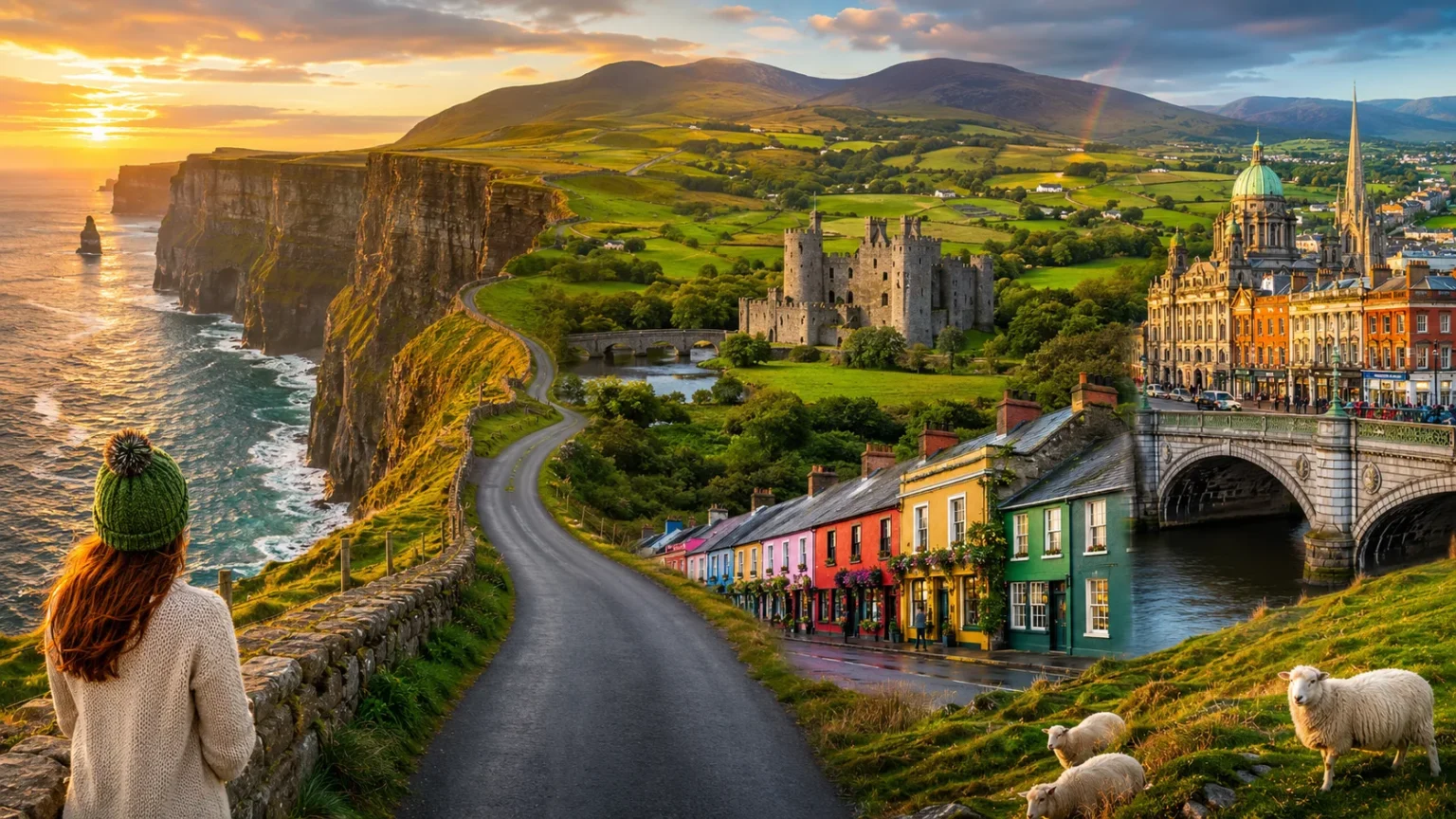
Top 10 Places to Visit in Ireland
Ireland packs an extraordinary amount of scenery, history, culture, and personality into a relatively compact island. Visitors can walk through medieval cities in the morning, drive beside Atlantic cliffs in the afternoon, and finish the day listening to traditional music in a lively pub. The top 10 places to visit in Ireland include famous cities, rugged national parks, coastal road trips, historic landmarks, and landscapes that look dramatically different depending on the weather. This guide covers destinations across the island of Ireland, including the Giant’s Causeway in Northern Ireland, which is part of the United Kingdom rather than the Republic of Ireland. Whether you are planning a first Ireland road trip or returning for a slower adventure, these places provide an excellent starting point.
1. Dublin – Best for History, Culture and a First Taste of Ireland
Dublin deserves a place near the beginning of almost every first-time Ireland itinerary because it combines centuries of history with the energy of a compact modern capital. The city is easy to explore on foot, particularly around Trinity College, Grafton Street, Temple Bar, the River Liffey, and the historic streets surrounding Dublin Castle and the cathedrals. Visitors can move quickly between museums, parks, pubs, Georgian architecture, literary landmarks, and contemporary restaurants without spending half the day in transit. Dublin also provides useful transportation connections with the rest of the country, making it a practical starting or finishing point for an Ireland road trip. Give the city at least two full days if your schedule allows.
Trinity College is one of the city’s defining attractions and remains particularly popular because of the Book of Kells Experience and the historic university setting. Trinity was founded in 1592, and its campus feels surprisingly calm considering its location beside some of central Dublin’s busiest streets. The Book of Kells is an Early Christian illuminated manuscript, while the Long Room has become one of Ireland’s most recognizable interior spaces. A 2026 Tourism Ireland guide continues to list Trinity and the Book of Kells among Dublin’s essential first-time attractions. Booking ahead is sensible during busy periods because popular entry times can sell out, especially during summer and weekends.
Dublin’s historical attractions go far beyond Trinity. St Patrick’s Cathedral and Christ Church Cathedral reveal different layers of the city’s religious and architectural history, while Kilmainham Gaol offers a much more political perspective on Ireland’s past. EPIC The Irish Emigration Museum focuses on the stories of millions of people who left Ireland and the impact of the Irish diaspora around the world. Guinness Storehouse remains another major visitor attraction, particularly for travelers interested in the history of Dublin’s famous stout and the view from its Gravity Bar. One useful 2026 planning detail is that Dublin Castle is closed to public visits until January 2027 while accommodating Ireland’s EU Presidency, so current itineraries should not assume its normal interior tours are operating.
The best part of Dublin is often what happens between major attractions. Walk through St Stephen’s Green, explore Georgian streets, browse independent shops, cross the Ha’penny Bridge, and spend time simply observing the city from a café or traditional pub. Temple Bar is famous and worth seeing, but visitors who want a less tourist-heavy evening should also explore pubs beyond its busiest blocks. Dublin has a strong literary identity associated with writers such as James Joyce, Oscar Wilde, Jonathan Swift, and Samuel Beckett, which adds another layer for culture-focused travelers. The city rewards people who leave room for wandering instead of organizing every hour around ticketed attractions. That human scale is one reason Dublin works so well as an introduction to Ireland.
For accommodation, staying centrally can save significant time if you have only one or two nights. Areas around Trinity College, St Stephen’s Green, the Docklands, and central north or south Dublin all provide different versions of the city, so compare location as carefully as hotel quality. Dublin is generally more expensive than smaller Irish towns, particularly during major events and peak summer dates, which makes early accommodation booking worthwhile. Travelers continuing into the countryside can pick up a rental car after exploring the city rather than paying for central parking while sightseeing on foot. Among the best places to visit in Ireland, Dublin provides the strongest combination of international access, museums, history, food, nightlife, and onward transportation.
2. Cliffs of Moher – Best for Ireland’s Iconic Atlantic Scenery
The Cliffs of Moher in County Clare are among Ireland’s most recognizable natural landmarks and one of the highlights most first-time visitors expect to see. The cliffs rise dramatically above the Atlantic on Ireland’s west coast, with views that can stretch toward the Aran Islands and Galway Bay when conditions are clear. Their exposed coastal setting means the experience changes constantly as clouds, wind, mist, sunlight, and Atlantic waves move through the landscape. Official visitor information describes the site as one of Ireland’s favorite attractions and notes its importance as a nesting area for seabirds. Even travelers who have seen hundreds of photographs often find the actual scale of the cliffs difficult to appreciate until standing beside them.
The main Cliffs of Moher Experience provides paved pathways and established viewing areas around the central visitor zone. Around 800 meters of paved routes lead to viewpoints from which the Aran Islands, Galway Bay, distant mountains, and portions of the Clare coastline may be visible in favorable weather. O’Brien’s Tower is another recognizable feature, although the real attraction is the changing perspective as you move along the cliff edge. Visitors should remain on designated safe routes and follow current safety information because sections of the wider coastal environment are exposed to severe weather and unstable cliff edges. Allowing at least two hours gives you enough time to explore without treating the cliffs as a quick roadside photograph.
Weather planning matters more here than at many other Ireland tourist attractions. The official Cliffs of Moher guidance emphasizes that conditions can move from fog to sunshine quickly and recommends arriving prepared for rain and suitable walking footwear. That unpredictability is part of the experience rather than necessarily a reason to cancel a visit. Mist can hide portions of the cliffs completely, while clearing skies may reveal dramatic Atlantic views only minutes later. If your itinerary is flexible, checking the national weather forecast on the day of your visit can help, but no forecast guarantees perfect visibility. A windproof or waterproof outer layer is valuable even when conditions look comfortable in nearby towns.
Doolin makes an excellent nearby base because it adds traditional music, restaurants, accommodations, and access toward the Aran Islands. Galway can also serve as a day-trip base, with the Cliffs of Moher located roughly 90 minutes away by road according to the official attraction website. Public transportation includes Bus Éireann Route 350 and TFI Local Link Route 351 between the Galway or Ennis direction and the cliffs. For the 2026 season, the free Burren & Cliffs Explorer Shuttle is also operating from May 21 through September 20 across parts of north and west County Clare. These alternatives are useful for visitors who want to experience the Wild Atlantic Way without driving unfamiliar rural roads.
Do not make the mistake of arriving in County Clare solely for the cliffs and immediately leaving. The surrounding Burren contains one of Ireland’s most unusual limestone landscapes, with prehistoric sites, distinctive flora, walking routes, and small villages that provide an entirely different experience from the coast. Doolin is famous for traditional music, while nearby areas provide opportunities for coastal exploration and ferries toward the Aran Islands. Spending a night locally also lets you consider an early or later visit when the central viewing areas may feel less pressured than during peak daytime tour-bus periods. The Cliffs of Moher are famous for good reason, but combining them with County Clare turns one attraction into a much richer part of an Ireland itinerary.
3. Galway City – Best for Music, Food and West Coast Atmosphere
Galway is one of Ireland’s most enjoyable small cities because its greatest attraction is not one monument but the atmosphere created by its streets, music, people, and Atlantic setting. Situated where the River Corrib reaches Galway Bay, the city combines medieval roots with an energetic arts, food, and festival culture. Tourism Ireland describes Galway as the beating heart of the west, where buskers fill central streets and cafés, pubs, and restaurants remain lively throughout the day. The center is compact enough to explore largely on foot, making Galway a comfortable destination after several days of driving. It is also one of the best bases for exploring Connemara, County Clare, and the Aran Islands.
The Latin Quarter is where many visitors first fall for Galway. Its narrow streets contain colorful storefronts, traditional pubs, restaurants, independent shops, and frequent street performances that make walking around feel like an activity in itself. Nearby, the Spanish Arch and Galway City Museum connect the modern atmosphere with the city’s maritime history. St Nicholas’ Collegiate Church and Galway’s weekend market provide additional stops that can easily fit into a relaxed morning rather than requiring complicated planning. Galway works especially well for travelers who enjoy exploring spontaneously because music or a busy pub can change the direction of an evening. There is rarely a need to build every hour around a checklist of formal attractions.
Salthill offers a completely different side of the city only a short distance from the historic center. The seaside neighborhood fronts Galway Bay and includes a promenade where locals walk, run, and take in changing views across the Atlantic. Tourism Ireland describes the Salthill promenade as roughly two kilometers long, making it manageable even for travelers with limited time. Watching sunset from this side of Galway can be one of the simplest memorable experiences in the city, especially after a busy day of sightseeing. If you stay more than one night, combining the compact medieval center with the open waterfront makes Galway feel larger and more varied than its size might initially suggest.
Galway becomes particularly energetic around its major annual festivals and events. Tourism Ireland highlights the Galway International Arts Festival, Galway Film Fleadh, Galway Races, and Galway International Oyster and Seafood Festival among the events that add another layer to the city’s cultural identity. Festival dates can be fantastic times to visit if the event interests you, but accommodation prices and availability may change substantially. Booking far ahead is therefore wise when your travel dates overlap with major celebrations. Outside festival periods, Galway still maintains a lively traditional music scene and strong restaurant culture. Seafood is especially appropriate given the city’s Atlantic location, although modern Galway dining extends far beyond conventional pub food.
Two nights is a strong minimum for travelers who want to experience Galway instead of simply seeing its center between day trips. Stay a third night if you plan to use the city as a base for Connemara, the Burren, Cliffs of Moher, or the Aran Islands. Tourism Ireland notes that Connemara lies around an hour west of the city, while the Irish-speaking Aran Islands are accessible from the Galway region by ferry. Galway therefore connects several of the top places to see in Ireland without feeling like a purely logistical base. Its combination of compact streets, traditional music, Atlantic air, nightlife, and day-trip possibilities makes it one of the easiest destinations to recommend to almost every type of traveler.
4. Killarney National Park – Best for Lakes, Mountains and Outdoor Adventures
Killarney National Park is one of the strongest examples of why Ireland’s landscapes deserve as much itinerary time as its towns and castles. Located beside Killarney in County Kerry, the park covers around 10,000 hectares of mountains, lakes, woodlands, waterfalls, and heritage sites. Ireland’s National Parks service notes that it was established from lands presented to the State in 1932, becoming Ireland’s first national park. The setting includes the famous Lakes of Killarney beneath the MacGillycuddy’s Reeks mountain range, producing some of the southwest’s most recognizable scenery. Because the park begins close to Killarney town, travelers can combine outdoor exploration with restaurants, accommodation, and evening entertainment without needing to stay somewhere isolated.
Muckross House and Gardens is one of the park’s major cultural attractions. The nineteenth-century Victorian mansion overlooks the surrounding landscape and contains period furnishings and historical interpretation, while its gardens become particularly colorful during late spring and early summer. Nearby Muckross Abbey adds a completely different atmosphere with its ruined Franciscan buildings, cloister, graveyard, and old yew tree. Torc Waterfall is another popular stop and can be incorporated into walking routes rather than treated only as a quick roadside attraction. Ross Castle, on the shore of Lough Leane, provides another excellent combination of history and lake scenery. Together these sites make Killarney much more than a conventional hiking destination.
Walking is one of the best ways to experience the national park because routes vary from short, easy trails to longer circuits. National Parks of Ireland lists options such as the Dundag to Torc path, the Ross Castle Mining Trail, the Lakeside Walk toward Muckross House, and longer routes around the Muckross Peninsula. Many offer views of lakes, woodland, mountains, and wildlife without requiring technical hiking skills. Cycling is also allowed on designated park routes, while traditional jaunting cars remain a distinctive way to see several popular areas. Boat trips operate on the lakes from locations including Ross Castle and the Old Boat House. This variety makes Killarney suitable for families, active couples, photographers, and travelers who simply want scenic walks.
Wildlife and conservation add another dimension that is easy to overlook when planning only around famous landmarks. The park protects Ireland’s last surviving indigenous herd of red deer and contains internationally important native woodland, including the extensive Reenadinna yew woodland. Lakes, streams, bogs, woodland, and mountain habitats support a diverse range of plants and animals across a relatively concentrated area. National Parks of Ireland also highlights Killarney’s status as a UNESCO Biosphere Reserve for conservation and research. Visitors can enjoy this landscape responsibly by using designated routes, respecting wildlife, and following restrictions such as the ban on recreational drones within the park. These details help preserve the very qualities that make Killarney one of Ireland’s outstanding natural destinations.
Killarney is also strategically important because it serves as a natural starting point for the Ring of Kerry. Travelers with limited time can spend one day exploring the national park and another driving part or all of the peninsula route, although two or three nights provide a much more comfortable pace. Killarney town itself has a large accommodation supply, pubs, restaurants, tour companies, and transport connections, which makes trip logistics relatively straightforward. Avoid scheduling every scenic drive back-to-back without leaving time for walking because the park is best experienced outside a vehicle. Among the top 10 places to visit in Ireland, Killarney is particularly valuable because one destination combines historic estates, castles, waterfalls, forests, wildlife, mountains, and famous lakes.
5. Ring of Kerry – Best for a Classic Ireland Road Trip
The Ring of Kerry is one of Ireland’s most famous scenic drives and a natural choice for travelers who imagine their trip involving winding roads, green hills, Atlantic views, beaches, villages, and mountain passes. The route circles the Iveragh Peninsula in County Kerry and traditionally begins and ends around Killarney. Tourism Ireland describes the route as approximately 179 kilometers long, with highlights including Moll’s Gap, Torc Waterfall, the Lakes of Killarney, coastal scenery, castles, and rivers. Driving it in one day is possible, but the experience becomes far more rewarding when you stop frequently. The objective should not be completing the loop as quickly as possible but allowing the road and landscape to determine the pace.
Several stretches feel dramatically different from one another. Near Killarney, mountains and lakes dominate the scenery, while the western and southern parts of the peninsula open toward broad Atlantic views and beaches. Tourism Ireland highlights Derrynane, Rossbeigh, and St Finian’s Bay among the area’s notable sandy beaches. Cahersiveen, Waterville, Sneem, Kenmare, and smaller villages give travelers opportunities to break up the drive for lunch, coffee, history, or an overnight stay. Scenic stops such as Ladies View provide classic perspectives over the Killarney landscape. By slowing down, the Ring becomes less like a tourist circuit and more like a journey through several different versions of County Kerry.
The Skellig Ring provides an additional detour for travelers who want an even more dramatic coastal experience. This western extension leads toward views associated with the Skellig Islands, including Skellig Michael, the remote island known for its early Christian monastery and striking position in the Atlantic. Access to Skellig Michael itself is controlled and weather-dependent, so visiting the island requires much more planning than simply driving the Ring of Kerry. Even without taking a boat, the surrounding coastline makes the detour worthwhile for road-trippers who have enough time. Narrow roads mean drivers should remain patient and avoid trying to cover excessive distance quickly. Ireland’s rural scenery is best enjoyed when the itinerary leaves room for unexpected stops.
Driving conditions deserve consideration, particularly for visitors unfamiliar with narrow Irish roads or left-side driving. Some sections are comfortable two-lane roads, while others become narrower and require more attention around bends, cyclists, buses, walkers, and local traffic. Starting early can help if you are traveling during busy summer periods, but simply leaving more time is equally important. If driving does not appeal, organized tours from Killarney provide an alternative that allows everyone in the group to enjoy the scenery rather than concentrating on navigation. Cycling the Ring is another established challenge for experienced riders, although it requires significantly more preparation. Whichever method you choose, resist measuring the day by distance alone.
The Ring of Kerry works best as part of a larger County Kerry stay rather than an isolated day trip from far away. Base yourself in Killarney if you want restaurants, nightlife, and national-park access, or choose a smaller peninsula town if you prefer a quieter coastal atmosphere. Travelers with three or four nights in the region can combine the Ring with Killarney National Park and then continue toward the Dingle Peninsula without feeling rushed. That route creates one of the most scenic sections of a longer Ireland road trip. The Ring’s popularity sometimes causes experienced travelers to dismiss it as too touristy, but the landscapes remain exceptional. Good timing and slower stops can easily restore the sense of discovery.
6. Dingle Peninsula – Best for Wild Coastlines and Small-Town Character
The Dingle Peninsula is one of the most beautiful areas in County Kerry and often becomes the place travelers talk about most enthusiastically after returning home. Dingle town provides a friendly harbor base with colorful streets, seafood, music, independent shops, and pubs, while the surrounding peninsula contains dramatic Atlantic coastlines and thousands of years of history. Tourism Ireland highlights places including Gallarus Oratory, Coumeenoole Beach, Conor Pass, Slea Head, and views toward the Blasket Islands. The landscape feels more intimate than a single major attraction because every few kilometers bring another beach, ruin, headland, village, or mountain view. For many visitors, Dingle represents exactly what they hoped rural Ireland would feel like.
Slea Head Drive is the peninsula’s signature road trip. The coastal route leaves Dingle and passes ancient stone structures, viewpoints, villages, cliffs, and Atlantic scenery before eventually returning toward town. Near Dún Beag and the Fahan area, travelers can see traditional stone structures, while Coumeenoole Beach creates one of the route’s most dramatic coastal stops. Tourism Ireland also points out connections between local landscapes and film productions, although the real reason to drive the route is the geography itself. Plan considerably more time than the route’s mileage suggests because frequent stops are inevitable. Driving patiently is essential on narrower sections, especially when meeting local traffic or larger tour vehicles.
Dingle town deserves at least one evening rather than being used simply as a parking point for the scenic drive. Tourism Ireland describes the town as bohemian and artistic, with shops, pubs, food experiences, and a strong creative identity. Traditional music is easy to encounter, and the compact center encourages people to move between restaurants and pubs on foot. Seafood is an obvious choice given the harbor setting, while local food producers and independent businesses add personality beyond the predictable tourist experience. Staying overnight also lets you explore parts of the peninsula earlier or later than day-trippers. That difference can be meaningful when viewpoints and narrow roads become busy during peak season.
Conor Pass provides another memorable route, linking Dingle with the northern side of the peninsula through a high mountain landscape. Tourism Ireland identifies it as Ireland’s highest mountain road and emphasizes its views across valleys, mountain slopes, and corrie lakes. The road is considerably narrower and more demanding than an ordinary highway, so drivers should review current access information and vehicle restrictions before attempting it. Travelers uncomfortable with tight roads can still experience the peninsula through other routes without feeling that they have missed the entire destination. Hiking and guided trips provide additional ways to explore. Dingle rewards travelers who choose experiences according to comfort rather than feeling obligated to complete every famous road.
Two nights is a good minimum for most travelers, while three allows a far more relaxed experience. Tourism Ireland even presents a three-day Dingle Peninsula trip concept, reflecting how much more there is to the region than one scenic loop. With extra time, visitors can consider boat trips, beaches, walking routes, historic sites, local food, or excursions connected with the Blasket Islands. Dingle also combines naturally with Killarney and the Ring of Kerry, although squeezing all three into two days undermines what makes them special. The peninsula deserves its place among the best places to visit in Ireland because it blends dramatic scenery with a town that is enjoyable after the sightseeing ends.
7. Connemara – Best for Mountains, Bogs and Untamed Landscapes
Connemara offers a completely different mood from Ireland’s busy cities and famous visitor attractions. West of Galway, the landscape becomes increasingly rugged, with mountains, blanket bog, lakes, rocky coastline, scattered settlements, and roads that seem to disappear toward the Atlantic. Connemara National Park protects thousands of hectares of this environment around Letterfrack and the Twelve Bens mountain range. The National Parks service describes the park’s terrain as a mixture of mountains, bogs, heaths, grasslands, and woodland, making it one of Ireland’s most varied protected landscapes. Connemara works particularly well for travelers who enjoy photography, hiking, scenic driving, and quiet places where the landscape matters more than a long list of built attractions.
The Diamond Hill trails provide one of the best ways to experience Connemara National Park on foot. Several routes begin near the visitor-center area, allowing travelers to choose according to fitness and available time. The Upper Diamond Hill route is classified as strenuous and climbs toward panoramic views over the Twelve Bens, Kylemore Abbey, and surrounding landscape. Easier woodland and lower trails provide alternatives for visitors who do not want to complete the summit route. Conditions can change rapidly, particularly on exposed higher ground, so appropriate shoes, waterproof layers, and a weather check are sensible. The reward is a view that explains why Connemara has such a strong reputation among landscape-focused visitors.
Kylemore Abbey is one of Connemara’s most recognizable landmarks and adds architectural interest to a region otherwise dominated by wilderness. Its dramatic lakeside setting beneath wooded and mountainous slopes makes the building as memorable from a distance as it is up close. Tourism Ireland frequently pairs Kylemore with wider Connemara travel because it fits naturally into drives through the region. Clifden is another useful stop and one of the area’s best bases, providing accommodation, restaurants, and access to scenic drives. Smaller communities such as Letterfrack and Leenane offer different perspectives on the region. Rather than racing from Galway to one attraction and back, a night in Connemara gives the landscape time to become the main experience.
Wildlife and traditional rural culture add depth beyond the famous viewpoints. Connemara National Park protects habitats associated with the region and maintains heritage breeds such as the renowned Connemara pony. The wider district also includes Irish-speaking communities, coastal villages, stone walls, beaches, and fishing landscapes that connect modern tourism with longstanding local traditions. Respectful travel matters because many beautiful roads and viewpoints pass through working communities rather than purpose-built tourist zones. Park responsibly, avoid blocking gates or roads, and follow marked trails instead of treating every attractive hillside as public access. Those small choices help keep scenic places enjoyable for residents as well as visitors.
Connemara can be visited on a long day from Galway, but staying overnight improves the experience substantially. Tourism Ireland describes the region as roughly an hour west of Galway city, making it easy to include within a west-coast itinerary without major detours. Travelers can combine Connemara with Galway before continuing south toward County Clare or north toward County Mayo depending on the larger route. Avoid judging the day by how many attractions you manage to visit; Connemara is most memorable when you have time to stop beside lakes, walk, watch weather move across mountains, and explore villages. Among Ireland’s scenic places, it offers some of the strongest evidence that emptier spaces can be as rewarding as famous landmarks.
8. Giant’s Causeway – Best for Geology, Myth and the Causeway Coast
The Giant’s Causeway is located in County Antrim in Northern Ireland, so travelers should understand that it is part of the island of Ireland but outside the Republic of Ireland. It remains too extraordinary to leave off a list of the top places to explore across the island. The UNESCO World Heritage Site contains more than 40,000 interlocking basalt columns created by volcanic activity over 60 million years ago. Their geometric shapes descend toward the sea in patterns that look almost deliberately constructed. Tourism Ireland presents the landscape through both geology and the traditional legend of giant Fionn mac Cumhaill, or Finn McCool. That combination of science, storytelling, and wild coastline gives the site a character unlike anywhere else in Ireland.
The stones themselves are only part of the experience. The surrounding cliffs and coastal trails provide wider views that reveal the scale of the Causeway Coast far better than standing exclusively at shoreline level. Tourism Ireland notes four marked walking trails for different abilities, including shorter clifftop options and the longer Causeway Coast Way. Visitors can learn about the formation and mythology of the area through the visitor center before descending toward the basalt formations. Appropriate footwear is useful because surfaces near the sea can become wet and slippery. As with other exposed coastal sites, weather changes the experience quickly, and dramatic cloud or rain can be visually impressive even when conditions are not conventionally perfect.
A major advantage of visiting the Giant’s Causeway is the number of other attractions packed along the surrounding coast. Dunluce Castle occupies an extraordinary cliff-edge position, while Carrick-a-Rede rope bridge provides another famous coastal experience. Bushmills offers an established whiskey-distilling tradition, and smaller coastal locations such as Ballintoy add opportunities for scenic stops. Tourism Ireland describes the broader Causeway Coastal Route as one of the defining journeys through Northern Ireland’s north coast. Instead of driving directly to the Causeway and returning immediately, build a full coastal day or overnight stay around the region. The surrounding landscape is easily strong enough to justify the additional time.
The geology becomes even more interesting when you understand how the columns formed. Ancient volcanic activity produced lava that cooled and contracted, creating the striking polygonal fractures visible today. Popular storytelling offers a completely different explanation involving Finn McCool constructing a route across the sea toward Scotland. Neither perspective diminishes the other as a visitor experience because the coexistence of geology and folklore is part of what makes the site memorable. Interpretive material at the visitor center helps travelers understand both dimensions before exploring outside. Families in particular may find the mythological story a useful entry point into learning about the landscape. For geology enthusiasts, the Causeway feels like a natural outdoor classroom.
The Giant’s Causeway can be visited on an organized day trip from Belfast, but staying along the north coast gives travelers more flexibility. An overnight stop around Bushmills, Portrush, Ballycastle, or another nearby base allows time for coastal walks and additional landmarks without constantly watching the clock. If your trip focuses only on the Republic of Ireland, reaching County Antrim may require a significant detour depending on your route, so it should be planned intentionally. For travelers visiting Belfast as well, however, the Causeway Coast fits naturally into the itinerary. It earns its place among the top 10 places to visit in Ireland because few destinations combine globally significant geology, dramatic coastal scenery, and memorable folklore so effectively.
9. Kilkenny – Best for Medieval Ireland and Castle Lovers
Kilkenny provides one of Ireland’s most accessible medieval-city experiences without the size or complexity of Dublin. Located within Ireland’s Ancient East, the city combines Kilkenny Castle, old churches, narrow streets, traditional pubs, crafts, and a compact historic center that can be explored largely on foot. Tourism Ireland describes Kilkenny as a city where medieval character and modern energy coexist, highlighting its twelfth-century castle, cobbled lanes, design scene, music, and historic attractions. It is close enough to Dublin to work as a day trip but rewarding enough for an overnight stay. Travelers interested in architecture, Irish castles, history, food, and smaller walkable cities should consider Kilkenny one of the strongest stops in southeastern Ireland.
Kilkenny Castle dominates the city from the River Nore and has more than 800 years of history. The site developed from a late twelfth-century Norman stronghold and was associated with the influential Butler family for more than six centuries. Extensive nineteenth-century remodeling created much of the grand-house character visible inside today, including richly decorated rooms, art, tapestries, and the impressive Picture Gallery. Outside, formal gardens and extensive parkland provide space to walk without leaving the center of the city. Tourism Ireland notes that the castle was transferred to Kilkenny in 1967 for a symbolic payment after falling into disrepair, after which restoration returned it to its current role as a major heritage attraction.
From the castle, the city’s Medieval Mile extends toward St Canice’s Cathedral and connects many of Kilkenny’s historic sites. Visitors can explore Rothe House, Black Abbey, the Medieval Mile Museum, old lanes, shops, pubs, and religious architecture without requiring transportation between every stop. St Canice’s has a round tower associated with one of the city’s oldest standing structures, providing another distinctive historical element. The compact layout makes Kilkenny particularly satisfying for travelers who prefer discovering a destination gradually on foot. Rather than moving from one isolated ticketed attraction to another, the streets themselves connect the historical story. This walkability is one reason a single well-planned day can feel surprisingly complete.
Kilkenny is not frozen in the Middle Ages, which helps prevent the city from feeling like an open-air museum. A strong crafts and design identity, restaurants, festivals, music, independent shops, and lively pubs create reasons to remain after formal attractions close. This balance works well for couples and friends who want historical sightseeing during the day but an enjoyable evening without needing to travel somewhere else. Staying overnight also allows you to experience the center after many day-trippers have departed. Accommodation ranges from traditional properties to contemporary hotels, so visitors can decide whether they want to continue the historic atmosphere or prioritize modern convenience. Either way, being close to the center allows you to explore primarily on foot.
Kilkenny fits particularly well into an itinerary connecting Dublin with southern destinations. Tourism Ireland places the city around 90 minutes from Dublin, making it an achievable addition without spending an entire day on transportation. Travelers heading toward Waterford, Cork, or other parts of Ireland’s southeast can use it as a natural overnight break. If castles and medieval architecture are central to your interests, spending the night is preferable to a short stop because the city offers enough detail for a full day. Kilkenny may not have the enormous natural drama of the west coast, but that contrast is exactly why it belongs in a balanced Ireland trip. It adds architecture, urban history, craftsmanship, and a human-scale historic center.
10. Glendalough and the Wicklow Mountains – Best for an Easy Nature-and-History Escape
Glendalough in County Wicklow combines two of Ireland’s strongest travel themes in one destination: dramatic scenery and ancient history. The valley lies within the Wicklow Mountains National Park and contains lakes, wooded slopes, mountain trails, and the remains of one of Ireland’s important early Christian monastic settlements. Tourism Ireland notes that St Kevin founded the community in the sixth century and that it eventually became a significant center of religion and learning. Today, the round tower, stone churches, graveyards, and surrounding valley create one of the most atmospheric historical landscapes within easy reach of Dublin. This combination makes Glendalough ideal for visitors who want nature and heritage without committing to a multi-day west-coast journey.
The monastic site is the natural starting point. Its tall round tower rises above the surrounding ruins and has become the most recognizable landmark in the valley. Nearby churches, gateways, gravestones, and archaeological remains reveal different periods in Glendalough’s long religious history. St Kevin’s Church is particularly distinctive, while stories associated with the saint extend to locations farther into the valley, including the area traditionally called St Kevin’s Bed. Walking through the ruins before exploring the lakes helps give context to the wider landscape. The valley becomes more meaningful when you understand that people came here for worship, learning, and retreat more than a thousand years before modern hikers arrived.
Beyond the historic ruins, walking routes lead visitors through woodland and around the lakes or toward higher viewpoints. The Wicklow Mountains provide options ranging from gentle walks to more demanding hikes, so the destination can suit casual day-trippers as well as outdoor enthusiasts. Weather can shift quickly, particularly on exposed higher routes, making waterproof layers and suitable footwear sensible even when Dublin is dry. Starting earlier gives you more time to choose a trail based on actual conditions rather than racing against daylight. During popular weekends and summer dates, earlier arrival can also make parking and the central monastic area easier to manage. The quieter sections of the valley often begin only after visitors move beyond the first historic landmarks.
County Wicklow offers several additional attractions that can turn Glendalough into part of a full-day or overnight excursion. Tourism Ireland highlights the wider national park, scenic Lough Tay, Powerscourt Estate and Waterfall, Bray, Brittas Bay, and landscaped gardens elsewhere in the county. Travelers with a rental car can therefore combine the monastic valley with mountain scenery and another Wicklow stop without covering extreme distances. Organized tours from Dublin are also widely used by visitors who do not intend to drive. The county’s nickname, the “Garden of Ireland,” reflects its strong association with green landscapes, estates, valleys, and mountains. Glendalough acts as the natural centerpiece around which many of these experiences can be planned.
Glendalough is especially valuable for short Ireland itineraries because it provides a convincing taste of rural scenery close to the capital. A traveler with only four or five days can spend time in Dublin and still experience lakes, mountains, old stone ruins, and woodland without traveling all the way to Kerry or Galway. Those with longer itineraries can use Wicklow as part of an eastern route toward Kilkenny and the southeast. The destination works year-round, although daylight, trail conditions, and weather should shape hiking plans. If your search for the top 10 places to visit in Ireland is driven by a desire to experience both landscape and history, Glendalough delivers those qualities in one remarkably concentrated valley.
Frequently Asked Questions
What are the top 10 places to visit in Ireland for first-time travelers?
A strong first-time list includes Dublin, the Cliffs of Moher, Galway, Killarney National Park, the Ring of Kerry, Dingle Peninsula, Connemara, the Giant’s Causeway, Kilkenny, and Glendalough. Together they provide a balanced mix of cities, castles, coastal scenery, national parks, historic sites, and memorable road trips.
How many days do you need to see Ireland?
Seven days can cover Dublin plus one or two regions comfortably, while 10 to 14 days is much better for travelers hoping to experience several destinations on this list without spending every day driving. Trying to visit all ten places in a single week would create a rushed itinerary and leave too little time for spontaneous stops.
What is the best time of year to visit Ireland?
Late spring through early autumn generally provides longer daylight hours for road trips and outdoor sightseeing, while July and August can bring larger visitor numbers and higher accommodation demand. Spring and early autumn can offer an appealing balance of daylight, scenery, and lighter crowds, but Ireland’s weather remains variable in every season, so waterproof layers are useful year-round.
Do you need a car to visit the best places in Ireland?
Dublin, Galway, Kilkenny, and several major attractions can be reached using trains, buses, and organized tours, so a car is not essential for every trip. Renting one becomes more valuable when exploring places such as the Dingle Peninsula, Ring of Kerry, rural Connemara, and smaller Wild Atlantic Way communities where flexibility is a major advantage.
Is the Giant’s Causeway in Ireland or Northern Ireland?
The Giant’s Causeway is in County Antrim, Northern Ireland, which is part of the United Kingdom, while remaining geographically on the island of Ireland. Travelers creating an all-island itinerary commonly combine it with Belfast and the Causeway Coast, while those visiting only the Republic of Ireland can substitute destinations such as the Aran Islands or another region if they prefer.