





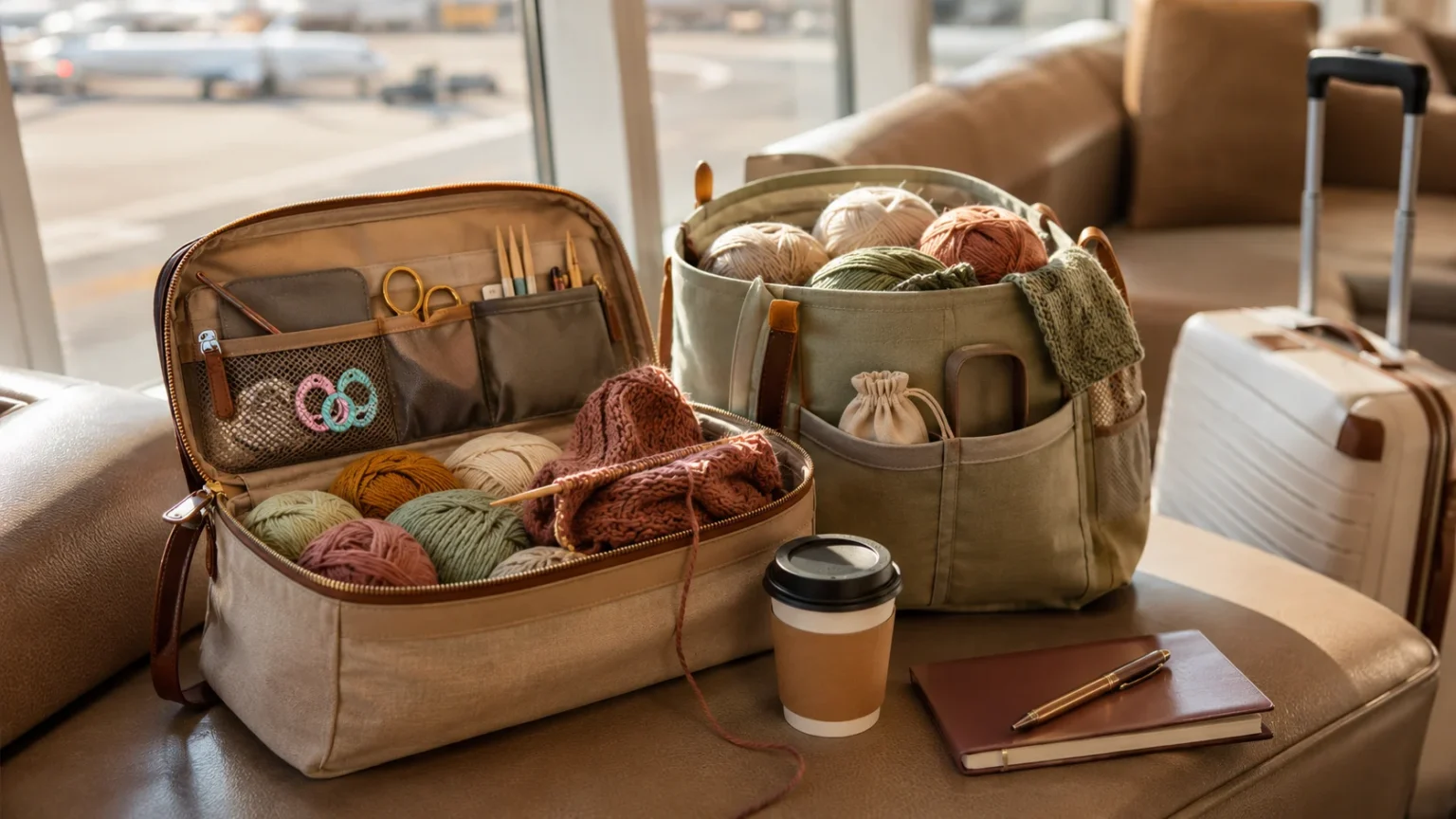
Best Knitting Project Bags for Travel: What to Look For
Taking a knitting project on a trip can make airport waits, long train journeys, quiet hotel evenings, and relaxing vacation afternoons much more enjoyable. The challenge is keeping yarn, needles, stitch markers, patterns, scissors, and unfinished work organized without allowing everything to become tangled inside your regular luggage.
The best knitting project bags for travel solve that problem without becoming another bulky item you regret packing. A good travel knitting bag should protect your work, keep yarn clean, prevent needles from damaging other belongings, and make the project easy to reach when you actually have time to knit.
Different trips call for different bags. A small drawstring pouch might be perfect for socks on a short flight, while a structured knitting tote may work better for a sweater or colorwork project requiring several yarn balls. Backpack-style organizers can be useful when your hands are already occupied with luggage.
The right choice therefore depends on project size, transportation method, knitting tools, and how much organization you prefer. Rather than choosing a bag simply because it looks attractive, consider its compartments, closure, portability, material, internal structure, and whether it genuinely fits the project you plan to take.
What Makes a Knitting Project Bag Good for Travel?
A travel knitting project bag should first be easy to carry. You may already have a suitcase, handbag, laptop bag, or backpack, so your knitting organizer should fit naturally into that system rather than creating an awkward additional piece of luggage.
Organization is equally important. Loose yarn can become tangled around chargers, toiletries, clothing, and other objects if everything shares one large compartment. Dedicated yarn sections, accessory pockets, and needle storage help keep knitting supplies separate and easier to access.
Protection matters as well. Knitting needles can bend, snap, snag fabrics, or poke through lightly constructed bags if they are not stored properly. Your work itself may also contain delicate stitches that can catch on zippers, keys, jewelry, or other objects in your luggage.
Finally, a good project bag should be convenient enough that you actually use it. If reaching your knitting requires unpacking half your suitcase, you are unlikely to pull it out during a short airport wait. Travel-friendly design should make knitting easier, not add another layer of organization to manage.
Choose the Right Bag Size for Your Knitting Project
The ideal size depends primarily on what you are knitting. Socks, mittens, hats, and other small projects usually require only one or two yarn balls, short circular needles or double-pointed needles, and a modest collection of notions, making a compact project pouch sufficient.
Scarves and shawls often need more room as the fabric grows. A bag that feels spacious at the beginning of a project can become surprisingly cramped halfway through, so consider the finished dimensions and expanding knitted fabric rather than evaluating only your starting materials.
Sweaters, blankets, and larger colorwork projects require significantly more capacity. A structured knitting tote or roomy yarn storage bag can hold several skeins while preventing them from becoming compressed beneath other travel belongings. Multiple compartments are especially helpful when working with several colors.
Avoid choosing the largest possible bag simply for flexibility. Oversized project bags encourage overpacking and consume valuable luggage space. The best travel bag is usually slightly larger than the complete project requires, giving your knitting room without carrying unnecessary bulk.
Drawstring Project Bags Are Excellent for Light Travel
Drawstring knitting bags are popular because their design is simple, lightweight, and easy to pack. With no rigid structure, they can flatten inside a suitcase when empty and expand around yarn and fabric once your project begins to grow.
They are particularly suitable for small projects such as socks, hats, baby items, and mittens. You can open the top quickly, remove your knitting, and begin working without navigating several compartments or complicated closures during a short travel break.
A smooth drawstring closure can also be gentler around yarn than some exposed zippers. When properly designed, there are fewer hard components inside the main compartment where delicate fibers might catch while you pull your work in and out.
The weakness is limited protection. A basic fabric pouch will not prevent needles from bending if heavy luggage presses against it. Travelers using drawstring bags should consider a separate needle protector or pack the project where it will not be crushed.
Zippered Knitting Bags Keep Supplies Secure
A zippered knitting project bag provides a more secure closure than an open tote or loosely closed pouch. This can be useful while traveling because the bag may be turned sideways, pushed beneath an airplane seat, or moved repeatedly between luggage compartments.
Zippers help prevent stitch markers, measuring tapes, yarn needles, and other small knitting notions from escaping into your suitcase. External zip pockets can also provide convenient storage for tools you want to reach without digging through the main project compartment.
However, zipper placement deserves attention. Yarn and unfinished knitting can occasionally catch in poorly positioned zipper teeth, especially if the opening is narrow. Look for bags with a wide opening and enough fabric clearance to keep your project away from the zipper track.
A high-quality zipper should operate smoothly without requiring excessive pulling. Travel creates repeated opening and closing, so durable hardware matters. A beautiful knitting bag quickly becomes frustrating when a weak zipper starts sticking during the first few trips.
Structured Knitting Totes Work Well for Larger Projects
Structured totes hold their shape rather than collapsing around the yarn. This makes them easier to place beside a chair, on a hotel floor, or near an airport seat while you knit because the opening remains accessible instead of folding inward.
They are especially useful for sweaters, shawls, and projects involving multiple yarn balls. Interior dividers can keep yarn separated, while side pockets organize notions, spare needles, printed patterns, and other tools that would otherwise disappear beneath the main project.
The additional structure can also provide limited protection against pressure and everyday bumps. Although a fabric knitting tote is not a hard case, reinforced walls generally protect contents better than a very thin pouch when packed alongside other travel belongings.
The trade-off is bulk. Structured totes do not compress easily inside a suitcase, so they make the most sense when you intend to use the knitting bag as part of your hand luggage or when you have enough packing space to accommodate its fixed shape.
Backpack-Style Knitting Bags Keep Your Hands Free
A knitting backpack can be one of the most convenient options for travelers who carry substantial supplies. Two shoulder straps distribute weight while leaving your hands free to pull luggage, hold travel documents, use your phone, or carry another personal item.
Backpack-style organizers often provide generous compartment systems. You may find dedicated spaces for yarn, needles, notions, tablets, patterns, water bottles, and personal belongings, making one bag useful for both knitting and general travel needs.
Some designs include yarn-feed openings that allow strands to pass through while the yarn remains inside the bag. These can be convenient when knitting at a destination, although they are less important when you prefer removing the complete project from the bag.
The main consideration is size. A large knitting backpack may be unnecessary for a single pair of socks and could use valuable cabin baggage allowance. Choose this style when you regularly travel with larger projects or want one organized bag to hold several crafting essentials.
Wristlet Project Bags Are Ideal for Small Projects
A wristlet knitting bag is a compact project pouch with a small carrying loop. It is particularly convenient for sock knitting because one project, a small yarn ball, circular needles, and basic notions can fit into a relatively small space.
The wrist strap allows you to carry your knitting independently without needing a full shoulder bag. At your destination, you can take the project to a café, garden, beach chair, hotel lobby, or waiting area without bringing your complete travel luggage.
Small project bags also encourage disciplined packing. Instead of bringing every knitting tool you own, you select only the needles, yarn, and notions required for the project. This can make travel knitting significantly simpler.
Their limitation is obvious: capacity. A wristlet that is perfect during the first inches of a project may become too small as a shawl or garment grows. Reserve this style for projects whose completed fabric will remain reasonably compact.
Look for Separate Yarn Compartments
Multiple yarn compartments can transform the experience of knitting while traveling, especially when a project uses several colors. Separate sections prevent balls and cakes from rolling into each other and reduce the amount of untangling required whenever you open the bag.
Dividers are particularly useful for stranded colorwork, stripes, and other projects that use more than one working yarn. Instead of allowing every strand to twist together inside one compartment, you can assign individual yarns their own sections.
The divider design should still provide enough flexibility for different projects. Permanently narrow compartments may limit which yarn cakes fit, while removable or adjustable dividers allow you to reconfigure the interior depending on what you are knitting.
For simple one-yarn projects, numerous compartments may be unnecessary. Every divider consumes space and adds complexity, so choose organization based on your real knitting habits rather than assuming more pockets automatically create a better project bag.
Needle Storage Should Be a Priority
Knitting needles need dedicated protection during travel. Straight needles can extend beyond small project bags, double-pointed needles can slip out of stitches, and interchangeable tips are easy to lose when stored loosely among yarn and accessories.
A good travel organizer may include long needle sleeves, elastic loops, zippered sections, or separate cases. These features stop hard needle tips from rubbing directly against delicate yarn while also reducing the chance of them poking through the outer fabric.
Circular needles are particularly travel-friendly because they take up relatively little room. However, spare circulars can become tangled if they are thrown together carelessly. Flat pockets or individual sleeves help maintain order and make the correct needle size easier to locate.
Whatever storage method you choose, avoid placing exposed needles loosely inside your main luggage. A dedicated needle section protects both the knitting equipment and surrounding belongings, particularly clothing and other fabrics that can snag on sharp or pointed tools.
Small Notions Need Their Own Pocket
Knitting involves numerous tiny tools that are easy to lose during travel. Stitch markers, tapestry needles, cable needles, row counters, measuring tapes, point protectors, small scissors, repair hooks, and removable markers can quickly disappear inside a large project compartment.
A zipped notions pocket keeps these items together. Ideally, it should be easy to reach without emptying your entire knitting bag. Transparent or mesh pockets can be particularly helpful because you can identify what is inside immediately.
Consider creating a compact travel notions kit rather than carrying your entire collection. Include only the tools your specific project might realistically require. A simple pouch with essential items reduces weight and makes it easier to notice when something is missing.
If you are flying, remember that regulations for scissors, cutters, and similar tools can vary between airports and countries. Check the current security requirements for every relevant departure point instead of assuming rules will be identical throughout your journey.
The Best Bag Closure Depends on How You Travel
Drawstrings offer lightweight simplicity and easy access. They work particularly well when your project stays inside another larger travel bag because the outer luggage provides additional security and protection during transportation.
Zippers provide stronger containment. If your project bag frequently sits beneath an airplane seat, moves through security trays, or gets transferred between several travel bags, a fully closed zipper reduces the likelihood of small supplies escaping.
Magnetic snaps and open totes provide quick access but offer less security when the bag tips over. They can work well around your destination but may be less reassuring when the project is moving through airports or crowded public transportation.
Roll-top and fold-over closures provide another option by combining flexibility with reasonable security. Whatever style you choose, make sure the closure does not catch yarn, press directly against knitting needles, or require complicated handling every time you want to knit.
Choose Fabric That Can Handle Real Travel
Travel bags inevitably encounter airport floors, car interiors, café tables, hotel rooms, outdoor benches, and other surfaces that may not be perfectly clean. Durable fabric therefore matters just as much as attractive prints when choosing a knitting project bag.
Cotton canvas is popular because it is strong, flexible, and available in many designs. Depending on construction, it can also be washable, which is valuable for a bag carrying yarn that you want to keep clean through repeated journeys.
Synthetic fabrics can offer lighter weight and improved resistance to minor moisture. Nylon and polyester project bags may be practical when traveling frequently, particularly if the outer surface can be wiped clean after being placed on public surfaces.
Whatever material you choose, check care instructions before washing the bag. Reinforcement, interfacing, zippers, leather details, internal coatings, and decorative elements can affect whether machine washing is appropriate. Easy maintenance is a significant advantage for frequent travelers.
Water Resistance Adds Useful Protection
Your knitting bag may encounter rain while moving between a hotel and taxi, condensation from a drink bottle, or accidental spills inside a larger tote. A water-resistant exterior can provide valuable temporary protection for yarn and unfinished work.
This is especially important with natural fibers that you would prefer not to expose unnecessarily to moisture or stains. A lightly coated fabric or tightly woven synthetic exterior can make small travel accidents much easier to manage.
Water-resistant should not be confused with waterproof. Most ordinary project bags have seams, zipper openings, and other areas where prolonged exposure can eventually allow water inside. They should not be relied upon to protect yarn during heavy rain for an extended period.
For wet destinations, consider carrying the project bag inside a more weather-resistant backpack or suitcase. Combining layers of protection is often more practical than expecting a soft knitting organizer to function as completely sealed outdoor equipment.
Interior Lining Should Be Smooth and Snag-Free
The inside of a knitting bag comes into direct contact with yarn and unfinished fabric, so rough seams or exposed hardware can create frustrating snags. A smooth lining protects delicate fibers every time you insert or remove the project.
Inspect internal zipper ends, hook-and-loop fasteners, unfinished seams, and decorative elements. Even a tiny rough area can repeatedly catch loosely spun yarn, laceweight fibers, or fuzzy materials during a long trip.
Light-colored lining can make small objects easier to find. Dark stitch markers and tapestry needles disappear quickly inside a black interior, whereas a contrasting fabric can make the bottom of the bag much easier to scan.
The lining should also be securely attached. Loose fabric can bunch beneath yarn cakes or become caught in a zipper. A well-constructed interior may not be the first feature you notice visually, but it contributes significantly to how enjoyable the bag is to use.
Yarn-Feed Holes Can Be Helpful—but Are Not Essential
Some specialized knitting bags include small grommets or eyelets that allow yarn to feed from inside the bag while you work. This keeps the yarn ball contained and can prevent it from rolling across floors or collecting dirt.
The feature is particularly convenient when knitting from several yarn balls arranged in separate compartments. Individual feed points can keep strands organized and make colorwork easier in environments where there is limited space beside your seat.
However, threading yarn through a fixed hole means the project and yarn can become effectively connected to the bag until the yarn is cut or finished. For travelers who frequently move projects between locations, this can reduce flexibility.
Many knitters therefore prefer an open-top bag that simply allows yarn to feed naturally over the edge. Consider yarn holes a useful optional feature rather than something every high-quality travel project bag must include.
A Wide Opening Makes Travel Knitting Easier
A wide opening allows you to see the contents and remove your project without pulling yarn against other supplies. This becomes especially useful when you have only a few minutes to knit before boarding begins or your next train arrives.
Wide openings also make larger projects easier to return to the bag. Trying to push a growing sweater through a narrow zip opening can compress the fabric and increase the chance of catching stitches on the hardware.
Structured openings can remain upright while the bag sits beside you, allowing the bag itself to act like a yarn bowl. Your yarn stays contained while feeding smoothly into your hands during the knitting session.
At the same time, the bag should still close securely for transportation. The ideal travel design combines convenient working access with a closure that protects everything once you need to pack up quickly.
Consider Whether the Bag Fits Inside Your Personal Item
One of the smartest travel strategies is choosing a project bag that fits inside your existing personal item or carry-on. This avoids creating an additional loose bag and keeps your knitting protected alongside the belongings you are already managing.
Measure the project bag when full rather than relying only on its empty dimensions. A soft pouch can expand significantly once filled with several yarn cakes, an unfinished garment, and a notions pouch.
For air travel, check the current baggage dimensions and personal-item rules of your specific airline. Policies can vary, and a knitting tote that works perfectly on one journey may be less convenient on another carrier with different allowances.
Compact project bags also make security checks simpler because the complete knitting setup can remain grouped together. If inspection is required, organized supplies are much easier to handle than loose needles, yarn balls, and notions scattered throughout a crowded backpack.
Best Knitting Project Bag for Plane Travel
For flying, a compact zippered or drawstring project bag that fits inside your personal item is usually an excellent choice. It gives you access to your knitting without requiring a separate large crafting bag through the airport.
Choose a project that does not require excessive yarn or equipment. Socks, hats, simple scarves, and smaller shawls are often easier to manage in confined seating than a large blanket with several bulky skeins.
Secure your stitches before moving through the airport. Point protectors, interchangeable cables, or another appropriate method can reduce the chance of stitches sliding away from your needles while the project is being moved or inspected.
Always verify current security rules at both your departure location and any airports involved in the return journey. Knitting needle policies can vary internationally, so something permitted on your outbound flight may receive different treatment elsewhere.
Best Knitting Project Bag for Road Trips
Road trips offer more flexibility because strict cabin baggage dimensions are not usually a concern. You can therefore choose a larger knitting tote containing additional yarn, spare needles, and more than one project if vehicle space allows.
A structured bag works especially well because it can remain upright on the floor or beside a passenger seat. Yarn stays contained rather than rolling around the vehicle when the road curves or the car stops suddenly.
Avoid placing the knitting bag beneath heavy suitcases or equipment. Even though yarn itself is soft, needles can bend and fragile tools can break when a loaded project bag is compressed for several hours.
Keep frequently used tools in a small accessible pocket so you do not need to unpack the vehicle whenever you want to knit during a rest stop or after arriving at your accommodation.
Best Knitting Project Bag for Trains and Buses
Train travel can be ideal for knitting because passengers often have more freedom to move and may have usable tray tables or wider seating areas. A medium-sized project bag with a stable base can sit conveniently beside your feet.
For buses and coaches, space can be more limited. A compact bag that fits beneath your seat or inside your personal item is usually easier to manage without interfering with neighboring passengers.
Shoulder handles can be helpful during transfers because you may need to board quickly while carrying other luggage. A bag that closes fully also reduces the risk of yarn or tools falling out while navigating stairs and crowded stations.
Keep the project relatively simple when you expect frequent interruptions. Complicated charts and numerous yarn changes may be less relaxing when stops, announcements, and luggage management continually demand your attention.
Best Knitting Bags for Sock Projects
Sock knitting is particularly travel-friendly because the project remains compact for most of its life. A small drawstring or wristlet project bag can hold yarn, needles, a few stitch markers, and the growing sock without wasting luggage space.
If you use double-pointed needles, choose a bag long enough to contain them completely and consider needle protectors to stop stitches from slipping off. Circular needle users can often fit their complete setup into an even smaller pouch.
A small internal notions pocket is valuable because sock projects may still require markers, a tapestry needle, measuring tape, or waste yarn. Keeping these supplies with the project means you can work without carrying a separate large tool case.
Because sock bags are small, they can easily move between a suitcase, backpack, handbag, and hotel room. This flexibility makes them one of the easiest ways to keep knitting available throughout a trip.
Best Knitting Bags for Sweaters and Larger Projects
A sweater requires more space not only for yarn but also for the fabric as it grows. Choose a roomy tote or structured project bag that can expand without tightly compressing the garment and working yarn.
Interior dividers can help when the project uses multiple balls, but make sure they do not steal too much space from the growing sweater. Removable compartments provide useful flexibility as your needs change throughout the project.
Strong handles become increasingly important as the bag gains weight. Several yarn skeins, needles, tools, and knitted fabric can become surprisingly heavy, so reinforced carrying points are preferable to delicate decorative handles.
For long trips, consider packing only the amount of yarn you realistically expect to use before returning home. Carrying every skein for a large sweater may consume valuable luggage capacity without providing any practical benefit.
How to Organize a Knitting Project Bag for Travel
Begin with the project itself and only the yarn needed for the trip. Keep working yarn positioned where it can be removed without pulling other objects out of the bag, and separate different colors when tangling is likely.
Place spare needles in dedicated sleeves or a separate needle case. Do not allow hard needle tips to move freely beside your knitting, especially when the bag will be compressed inside larger luggage.
Create one compact notions pouch containing stitch markers, measuring tape, tapestry needle, point protectors, and other project-specific tools. Keeping tiny accessories inside a secondary pouch makes switching between bags much easier.
Finally, include your pattern in the format that suits you best. Digital patterns reduce paper clutter, but travelers who prefer printed instructions can place pages inside a protective sleeve so they remain readable throughout the journey.
Avoid Overpacking Your Knitting Bag
Travel excitement can make it tempting to pack three projects for a weekend because you imagine having hours of uninterrupted knitting time. In reality, sightseeing, meals, conversations, work, and transportation often leave less crafting time than expected.
Choose one main project and perhaps one compact backup if your trip is long. A simpler packing strategy reduces yarn weight and eliminates the need to carry several sets of needles and separate notions.
Avoid packing supplies merely because you might theoretically need them. An entire interchangeable needle collection is unnecessary if your project requires only one known size and you are not planning to start something different.
A lighter knitting bag is easier to carry and easier to organize. Travel knitting should feel relaxing rather than like transporting a miniature craft store everywhere you go.
Features Worth Paying More For
Durable construction is worth prioritizing because travel places more stress on a project bag than home storage. Reinforced seams, dependable zippers, strong handles, and quality lining can extend the useful life of the bag considerably.
Thoughtful organization can also justify a higher price when it matches your needs. Useful pockets, removable dividers, protected needle storage, and a stable base can save repeated frustration over years of travel.
Comfort deserves consideration if the bag will be carried independently. Wider handles, padded shoulder straps, or a comfortable wrist loop can make a significant difference during airport transfers and long walks.
Decorative details should come after functionality. A beautiful print can make the bag enjoyable to own, but style should not compensate for weak stitching, poor closures, rough interiors, or dimensions that do not fit your typical knitting projects.
Common Mistakes When Buying a Travel Knitting Bag
The first mistake is choosing based only on appearance. A beautiful project bag may photograph well while lacking enough room for your needles, proper closures, or a smooth lining capable of protecting delicate yarn.
Another mistake is buying too large. Extra space seems helpful until the bag becomes filled with unnecessary supplies and takes up half your personal-item allowance on every journey.
Ignoring the type of knitting needles you use can also create problems. Long straight needles, double-pointed needles, and circular needles require different storage arrangements, so confirm that the bag can contain your preferred tools securely.
Finally, do not ignore your travel style. Someone who flies monthly needs different features from someone who drives to a vacation home twice a year. Your transportation habits should shape the bag choice just as much as your knitting preferences.
How to Choose the Best Knitting Project Bag for You
Start by identifying the project size you travel with most frequently. If you mainly knit socks and hats, choose a compact pouch rather than buying a large tote simply because it offers more compartments.
Next, consider how you travel. Frequent flyers should prioritize compact dimensions and secure closures, while road travelers can take advantage of larger structured bags. Public-transport users may value shoulder straps or backpack-style carrying.
Then evaluate organization. Decide whether you need separate yarn compartments, needle storage, notions pockets, a pattern sleeve, or just one simple open interior. The best organization system is the one that matches how you naturally work.
Finally, inspect construction and materials. Smooth lining, durable fabric, strong seams, dependable closures, and comfortable handles matter far more over time than decorative extras. A well-designed bag should quietly make travel knitting easier every time you use it.
Final Thoughts on the Best Knitting Project Bags for Travel
The best knitting project bags for travel balance portability, organization, and protection. They hold the project securely without taking more luggage space than necessary and make your yarn easy to access whenever a few free minutes appear.
For small projects, drawstring bags and wristlets provide lightweight simplicity. Zippered organizers offer additional security, while structured totes and knitting backpacks are better suited to sweaters, multiple yarn balls, and longer trips.
Look closely at features that affect everyday use: smooth lining, secure closures, needle protection, notions storage, durable fabric, comfortable handles, and dimensions that work with your luggage. Those details often matter more than the number of decorative pockets.
Most importantly, choose a bag that suits the way you actually knit and travel. The right organizer lets you spend less time searching for tools and untangling yarn—and more time enjoying the project wherever your journey takes you.
Frequently Asked Questions
What is the best type of knitting project bag for travel?
A zippered or drawstring bag works well for small travel projects, while structured totes and knitting backpacks are better for sweaters or multiple yarn balls. The best option depends on your project size and transportation.
What size knitting project bag should I buy?
Choose a bag slightly larger than your finished project’s expected bulk. Socks and hats need little space, while shawls, sweaters, and colorwork projects require additional room for fabric and yarn.
Can I take knitting needles on a plane?
Rules depend on the country, airport, and security authority. Knitting needles may be permitted in many locations, but always check the current rules for your departure and return airports before traveling.
What should I keep in a travel knitting bag?
Pack your project, required yarn, needles, stitch markers, tapestry needle, measuring tape, point protectors, pattern, and only the additional notions you realistically expect to use.
Are knitting backpacks better than project totes?
Backpacks are useful when you need hands-free carrying and substantial storage. Totes can be easier to access while knitting, so the better choice depends on how much equipment you carry and how you travel.