





Jumping Spider: Identification, Bites & Interesting Facts
Jumping spiders are small, highly active spiders known for their remarkable eyesight, quick movements, and ability to leap several times their own body length. They belong to the family Salticidae, one of the largest spider families in the world, with thousands of known species living across many different environments. Unlike web-building spiders that wait for insects to become trapped, jumping spiders usually hunt by stalking prey and making carefully controlled jumps. Their large forward-facing eyes give them an almost expressive appearance that many people find less intimidating than other spiders. Most jumping spiders are harmless to humans and prefer escaping rather than biting when disturbed. Understanding their appearance and behavior can make these fascinating animals easier to recognize and appreciate.
Jumping spiders vary greatly in color, size, and pattern depending on the species. Some are brown or gray and blend easily into tree bark, walls, or soil, while others display brilliant green, red, orange, blue, or metallic markings. Their compact bodies, relatively short legs, and prominent front eyes are among the easiest features to recognize. They can be found in gardens, forests, grasslands, homes, sheds, and even urban buildings where insects are available. Because they actively explore their surroundings during the day, people may occasionally find one walking across a windowsill, wall, or outdoor furniture. Their presence usually reflects an available supply of small insects rather than a dangerous infestation.
Although jumping spiders are capable of biting, bites are uncommon and generally occur only when a spider is trapped against the skin or handled roughly. Most species do not have venom considered medically significant to healthy humans. A bite may cause temporary redness, mild swelling, itching, or localized discomfort similar to other minor insect or spider bites. Serious symptoms are unusual, although anyone experiencing difficulty breathing, severe swelling, spreading redness, or intense pain should seek medical care. This guide explains how to identify jumping spiders, where they live, whether they are dangerous, what their bites may feel like, and some of the most interesting facts about their unusual behavior.
What Is a Jumping Spider?
Jumping spiders are members of the spider family Salticidae, a diverse group found on nearly every continent except Antarctica. They are classified as arachnids, meaning they have eight legs and belong to the same broad group as other spiders, scorpions, mites, and ticks. Salticids are especially distinctive because they rely heavily on vision instead of building large prey-catching webs. Their eyes help them locate insects, judge distances, recognize potential mates, and detect approaching threats. They usually hunt during daylight hours when visual information is most useful. This active hunting lifestyle distinguishes them from many spiders that spend most of their time waiting in webs.
Most jumping spiders are relatively small, although exact size varies between species. Many measure only a few millimeters long, while some larger species can approach or exceed a centimeter in body length. Their bodies tend to look compact and sturdy rather than long and delicate. The cephalothorax, which includes the head and front portion of the body, often appears relatively large because it contains the spider’s complex eyes. The abdomen can be rounded, elongated, patterned, hairy, or metallic depending on the species. This tremendous diversity can make exact species identification challenging without careful examination.
One of the defining characteristics of jumping spiders is their ability to leap rapidly. They do not use large muscular legs in exactly the same way mammals jump. Instead, spiders can change hydraulic pressure within their legs, allowing them to extend their limbs quickly and launch themselves through the air. Before making a jump, many species attach a silk safety line to the surface. If they miss their target or fall, the silk can help prevent uncontrolled drops. This combination of hydraulic movement and silk makes jumping spiders remarkably agile hunters.
Unlike orb-weaving spiders, jumping spiders usually do not construct large webs for capturing prey. They still produce silk, however, and use it in several important ways. Silk may form safety lines during jumping, create resting shelters, protect eggs, or provide temporary hiding places during molting. Some species build small silk retreats underneath leaves, bark, or furniture. These shelters may look like little white sacs or tubes rather than traditional spider webs. Finding one does not necessarily mean a large colony is nearby because jumping spiders are usually solitary.
Jumping spiders play an important ecological role by controlling insect populations. They prey on flies, mosquitoes, moths, small beetles, aphids, and many other invertebrates. Some species can even capture prey larger than themselves by carefully stalking and striking at vulnerable moments. Their hunting activity can therefore benefit gardens and agricultural environments by reducing certain pest insects. Because they generally pose little danger to humans, many gardeners prefer leaving them undisturbed. A jumping spider on a plant is often more helpful than harmful.
How to Identify a Jumping Spider
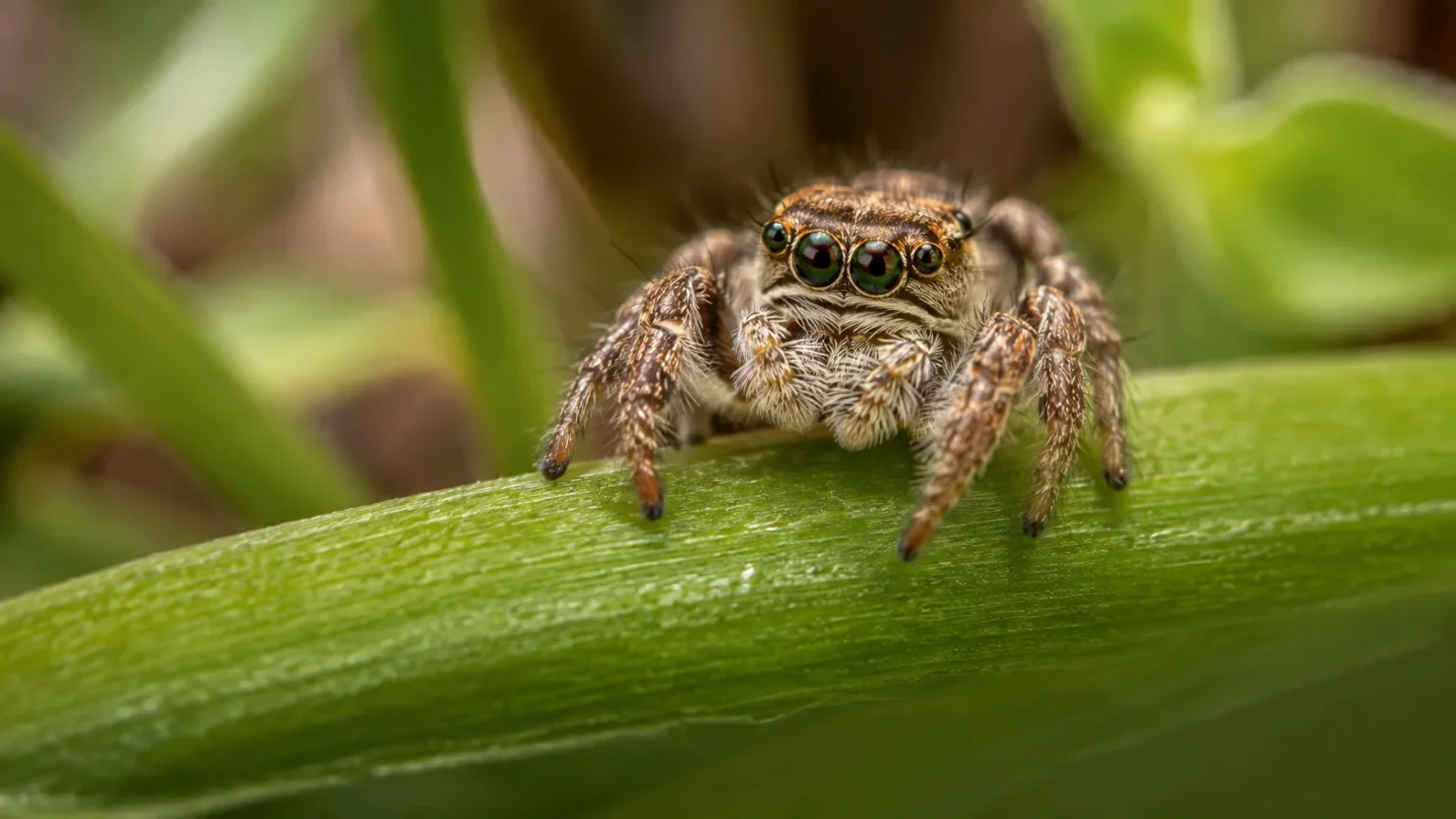
The easiest way to identify a jumping spider is usually by looking at its eyes. Jumping spiders have eight eyes arranged in a distinctive pattern, with two especially large forward-facing central eyes. These prominent eyes give the spider excellent detail perception and make the face appear unusually expressive. Smaller eyes surround the larger pair and help provide wide-angle awareness of movement. Most other common spiders do not have such large forward-facing eyes. If a tiny spider appears to be looking directly at you, there is a good chance it belongs to the jumping spider family.
Body shape provides another clue. Jumping spiders generally have compact bodies and relatively short, sturdy legs compared with long-legged house spiders. Their front legs may appear slightly more prominent and are sometimes raised during hunting, communication, or defensive displays. The body often looks fuzzy because many species have fine hairs covering the legs and abdomen. These hairs can contribute to distinctive patterns and may also help the spider sense movement or air currents. Their overall posture tends to look alert and upright rather than flat against the surface.
Movement is particularly characteristic. Instead of moving steadily through a web, jumping spiders often walk in short bursts, pause, turn toward movement, and suddenly jump from one location to another. They may appear to track a person’s hand or camera because they actively use their vision to investigate nearby objects. A spider that turns its body to face you when you move may be displaying typical salticid curiosity. These spiders are generally more visually responsive than many other species. Their quick, deliberate movements can make them surprisingly entertaining to observe.
Color and markings vary enormously. Some common jumping spiders are black with white spots, while others are brown, tan, gray, orange, green, or multicolored. Male bold jumping spiders may appear mostly black with contrasting spots and metallic green or blue mouthparts. Zebra jumping spiders often have black-and-white striped markings that help explain their name. Peacock spiders, found primarily in Australia, are famous for brightly colored males with elaborate courtship displays. Because coloration varies so widely, eye pattern and behavior are often more reliable identification features than color alone.
Habitat can also support identification. Jumping spiders commonly appear on sunny walls, fences, tree trunks, leaves, windows, decks, and garden furniture. They frequently explore locations where insects gather, particularly near lights and windows. Inside homes, they may walk across walls or windowsills during the day. They are less likely to remain hidden in dark basements than some nocturnal spider species, although individuals can still wander into sheltered spaces. Their preference for visually hunting in well-lit areas makes daytime sightings particularly common.
Where Do Jumping Spiders Live?
Jumping spiders occupy an extraordinary range of habitats around the world. Different species live in tropical rainforests, deserts, temperate woodlands, grasslands, mountains, wetlands, agricultural fields, and urban areas. Their adaptability has helped make Salticidae one of the most diverse spider families. Some species specialize in specific plants or microhabitats, while others tolerate a wide range of environments. As long as suitable prey and shelter are available, jumping spiders can often establish themselves successfully. Their global distribution means people can encounter them in many climates.
Gardens are particularly good places to find jumping spiders. Leaves, stems, fences, flowers, and outdoor structures provide elevated surfaces from which spiders can scan for insects. Aphids, flies, mosquitoes, caterpillars, and other small arthropods create an abundant food supply. Jumping spiders may move from plant to plant throughout the day searching for hunting opportunities. Because they are predators rather than plant feeders, they do not chew leaves or damage vegetables. Their presence can actually contribute to natural pest control.
Trees and shrubs also provide ideal habitat. Bark offers camouflage and small crevices where spiders can rest or molt. Certain species closely match the texture and color of bark, making them difficult to see until they move. Leaves can provide hunting platforms as well as protected areas for silk retreats. Some jumping spiders live high in vegetation, while others remain close to the ground. The exact habitat depends heavily on species and prey availability.
Human structures create additional opportunities. Exterior walls receive sunlight and attract insects, making them useful hunting grounds. Windows attract flies and other small insects, which can draw jumping spiders into buildings. They may enter through open doors, window gaps, or small cracks. Finding one indoors usually does not indicate structural damage or a dangerous infestation. The spider may simply have followed prey or accidentally wandered inside.
Inside a home, jumping spiders often remain near windows, houseplants, or bright areas. They may survive for a while by feeding on small flies, gnats, or other insects. People who do not want spiders indoors can usually relocate them by placing a cup over the spider, sliding stiff paper underneath, and releasing it outside. There is generally no need for insecticide when dealing with a single jumping spider. Preventing excessive indoor insect populations also makes homes less attractive to predatory spiders.
Are Jumping Spiders Dangerous?
Jumping spiders are generally considered harmless to humans. They are predators equipped with fangs and venom, but their venom is primarily used to immobilize small insect prey rather than defend against people. Most species are reluctant to bite unless trapped, squeezed, or handled aggressively. Their first response to disturbance is usually to jump or run away. Because they have excellent eyesight, they often notice approaching threats early and move to safety. Simply seeing a jumping spider nearby is not a reason for alarm.
The venom of common jumping spiders is not generally considered medically significant for healthy adults. A bite may produce mild localized symptoms, but severe poisoning is not expected from typical salticid species. This differs from medically important spiders such as certain widow or recluse species whose venom can occasionally cause more significant effects. Visual confusion sometimes occurs because dark jumping spiders can be mistaken for other species at a glance. Their large forward-facing eyes and compact body usually help distinguish them. Proper identification is more useful than assuming every dark spider is dangerous.
Children and pets are also unlikely to be harmed by normal encounters with jumping spiders. Most spiders are too small and defensive to pose a realistic threat unless they are physically trapped. A curious pet may attempt to paw at or eat one, but serious toxicity from common jumping spiders is not expected. However, any animal that develops facial swelling, vomiting, breathing problems, or significant pain after a suspected bite should be evaluated by a veterinarian. The exact cause may not always be the spider that happened to be nearby.
People with severe allergies or unusual sensitivity may theoretically experience stronger reactions to many bites or stings, although this is not a typical feature of jumping spider bites. Infection is another possible complication if broken skin is scratched repeatedly or contaminated. Keeping the area clean reduces this risk. A suspected bite that becomes increasingly swollen, hot, painful, or filled with pus after several days may need medical evaluation. Worsening symptoms can result from infection rather than venom itself.
The greatest risk associated with jumping spiders may actually come from misidentification. Someone who assumes every spider bite is harmless could overlook a more serious condition, while someone who assumes every spider is dangerous may use unnecessary pesticides. Spider bites are also commonly blamed for skin lesions that were actually caused by bacterial infections, insect bites, or other dermatological conditions. If a spider was never seen biting, the cause of a skin lesion may remain uncertain. Symptoms and progression matter more than guesswork.
What Does a Jumping Spider Bite Look Like?
A jumping spider bite is uncommon because these spiders generally avoid biting people. When a bite does occur, it is usually associated with accidentally trapping the spider against the skin or handling it directly. The initial sensation may feel like a small pinprick or sting. Some people may barely notice the bite when it happens. A tiny red spot can develop afterward. Mild tenderness around the area is possible as the skin reacts to the puncture and venom.
Localized redness is one of the most likely visible reactions. The surrounding skin may become slightly raised or swollen for a short period. Itching can occur as the body’s immune response develops. These symptoms often resemble a mosquito bite or another minor insect bite. There is no unique appearance that allows someone to identify a jumping spider bite with certainty from a photograph. Many minor bites, rashes, and irritated follicles can look similar.
Pain is generally mild when it occurs. The bite may feel tender for several hours or occasionally longer, but intense worsening pain would be unusual. A small amount of swelling can remain around the bite site before gradually resolving. Cold compresses wrapped in cloth may help with temporary discomfort or swelling. Keeping the area clean with soap and water can reduce the chance of secondary infection. Scratching should be avoided when possible.
Blistering, extensive tissue damage, or rapidly spreading discoloration is not typical of a straightforward jumping spider bite. If such symptoms occur, another diagnosis should be considered. Severe bacterial skin infections can sometimes be mistakenly labeled spider bites because they produce redness, pain, swelling, or pus. Certain actual medically significant spider bites may also require different management. Any lesion that becomes substantially worse instead of gradually improving deserves medical attention.
Difficulty breathing, facial swelling, widespread hives, fainting, or rapidly increasing swelling requires emergency medical care because these symptoms can indicate a severe allergic reaction. Such reactions are uncommon but should always be treated seriously regardless of the animal involved. Fever, red streaks spreading from the bite, pus, or persistent worsening pain can suggest infection. People with weakened immune systems, diabetes, or circulation problems may need earlier evaluation when skin wounds are not healing normally.
What to Do After a Suspected Jumping Spider Bite
The first step is to wash the area gently with soap and water. This removes surface dirt and bacteria that could enter through broken skin. There is usually no need to scrub aggressively or use harsh chemicals. Alcohol, bleach, or concentrated antiseptic products can irritate the skin and delay healing. Pat the area dry with a clean towel after washing. Most minor bites require little additional care.
A cold compress can help reduce mild swelling or discomfort. Wrap ice or a cold pack in a cloth rather than placing it directly against the skin. Short applications are generally enough to provide relief. If itching becomes bothersome, an appropriate over-the-counter antihistamine or topical product may be considered according to normal safety instructions and individual health conditions. People taking other medications should check for interactions when necessary. Most mild reactions improve with basic supportive care.
Monitor the area for the next day or two. A small red mark that gradually becomes less painful is reassuring. Taking a photograph can help document whether swelling or discoloration is expanding. Constant touching or squeezing is unnecessary and can introduce bacteria. Do not attempt to cut the bite, suck out venom, or apply extreme heat. These approaches do not provide useful treatment and may cause additional injury.
If the spider is safely available, a photograph may help with identification, but capturing it is not worth risking another bite. Jumping spiders can often be recognized from a clear image showing the face, body, and markings. There is no need to kill the spider simply to obtain proof. In many cases, the exact species will not change treatment when symptoms remain mild. Medical decisions should be based primarily on the reaction and overall health.
Seek medical care when symptoms become severe, unusual, or progressively worse. Large swelling, worsening pain, fever, pus, red streaks, tissue discoloration, or systemic symptoms are not features to manage indefinitely at home. A healthcare professional can determine whether the problem is an allergic reaction, bacterial infection, another type of bite, or an unrelated skin condition. When a spider bite is genuinely mild, reassurance and simple wound care are usually all that is needed.
How Jumping Spiders Hunt
Jumping spiders are visual hunters that actively search for prey instead of depending primarily on capture webs. A spider may climb to an elevated surface and scan the surrounding area for movement. When it spots an insect, it often turns its large central eyes toward the target and begins approaching slowly. This behavior resembles stalking more than traditional web hunting. The spider may stop repeatedly to judge distance and choose the best angle. Once close enough, it prepares for a rapid strike.
Distance judgment is particularly impressive because a jumping spider needs to land accurately. Its large principal eyes provide high-resolution vision, while additional eyes help detect movement from other directions. Before jumping, the spider may adjust body position carefully and anchor a silk line behind itself. This safety line can help it recover if the jump fails. The spider then rapidly extends its legs and launches toward the prey. Successful strikes can happen too quickly for the human eye to follow easily.
After capturing an insect, the jumping spider uses its fangs to inject venom. The venom immobilizes the prey and begins breaking down internal tissues. Like other spiders, jumping spiders cannot chew solid food in the same way mammals do. Instead, they consume liquefied nutrients from the prey. The meal may take considerable time relative to the brief attack. After feeding, the spider leaves the remains behind and resumes hunting later.
Jumping spiders are capable of attacking a wide range of small arthropods. Flies are common prey because they frequently land on exposed surfaces. Mosquitoes, moths, aphids, beetles, and other spiders can also be captured. Some specialized species have unusual diets. A few jumping spiders feed partly on plant material, while others specialize in hunting particular insects or spiders. This dietary diversity reflects the enormous number of salticid species.
Hunting strategies can involve surprising levels of flexibility. Some jumping spiders alter their approach depending on the prey they are pursuing. A fast-moving fly may require a different stalking strategy from a dangerous spider capable of fighting back. Research into spider behavior has contributed to scientific interest in animal cognition because some species appear capable of planning indirect routes toward prey. Despite their tiny nervous systems, they can perform behaviors that look remarkably sophisticated.
Jumping Spider Eyes and Vision
Jumping spiders have some of the most advanced vision found among spiders. Their eight eyes are divided into different functional groups rather than all providing identical information. The two large central eyes, often called principal eyes, are responsible for detailed vision. These eyes are shaped more like small telescopes than ordinary simple spider eyes. Internal structures can move, allowing the spider to examine objects without moving its entire head. This helps explain why a jumping spider may appear to stare directly at a person.
The smaller surrounding eyes provide a wider field of view. They are particularly useful for detecting motion approaching from the sides or behind. When one of these secondary eyes notices movement, the spider can turn toward it and examine the object using the central eyes. This combination gives the spider both broad surveillance and detailed focus. It is highly useful for an animal that must simultaneously hunt prey and avoid predators. Vision is central to nearly every part of jumping spider behavior.
Many species can perceive color, although the exact color sensitivity differs among groups. Certain jumping spiders can detect wavelengths humans cannot see, including ultraviolet light. This ability plays an important role in communication and courtship. Markings that appear ordinary to human eyes may look dramatically different to another spider. Males of colorful species can use these visual signals to attract females. Their courtship displays may combine movement, color, and vibration.
Depth perception helps jumping spiders calculate accurate leaps. Because the principal eyes have unusual layered retinas, the spider can use visual information to estimate how far away an object is. Accurate distance estimation is essential because missing a prey item by a few millimeters can mean losing the meal entirely. The spider’s ability to perform these calculations with a tiny brain continues to interest scientists studying visual systems. Their eyes demonstrate that complex visual processing does not require a large animal body.
The spider’s visual behavior also contributes to its popularity among people who enjoy observing arachnids. Jumping spiders often turn toward cameras, fingers, or nearby movement. This makes them appear curious or even interactive compared with many other spiders. Human interpretations such as friendliness should still be used cautiously because spider behavior does not necessarily reflect emotions in the same way ours does. Nevertheless, their responsiveness makes them especially engaging animals to watch.
Jumping Spider Courtship and Mating
Courtship among jumping spiders can be surprisingly elaborate. Males often rely on colorful markings, leg movements, body vibrations, and carefully timed displays to attract females. Because females are capable predators, approaching incorrectly can be dangerous for the male. A courtship display communicates that the approaching spider is a potential mate rather than prey. Males may wave their front legs, move side to side, vibrate their abdomen, or perform repeated patterned movements. Different species have distinctive courtship styles.
Peacock spiders are among the most famous examples. Males have brightly colored abdominal flaps that can be raised and displayed like tiny fans. They combine these colors with rhythmic leg waving and body movements. Females watch the performance and may accept or reject the male depending on the quality of the display. Poor timing or inappropriate approach can cause the female to leave or behave aggressively. These elaborate behaviors have made peacock spiders popular in wildlife photography.
Vibrations can be just as important as visual signals. A male may produce vibrations through the surface on which the spiders are standing. These signals can be transmitted through leaves, bark, or other materials and detected by the female. Combining visual and vibrational communication may provide information about species identity and male quality. Researchers can record these signals using sensitive equipment even when humans cannot detect them naturally. The complexity of the communication system is remarkable for such small animals.
After successful mating, female jumping spiders produce eggs and protect them within silk structures. A female may build a secure retreat and remain near the egg sac while embryos develop. Some species show surprisingly strong maternal guarding behavior. She may become less active while protecting the eggs and can respond defensively to disturbances. Once spiderlings hatch, they eventually leave the retreat and begin living independently. There is generally no prolonged parental care after dispersal.
Young jumping spiders go through multiple molts as they grow. During molting, the spider sheds its old external skeleton and forms a larger one. A spider preparing to molt often retreats into a silk shelter and becomes inactive. Disturbing a spider during this vulnerable period can be harmful because the new exoskeleton is initially soft. After hardening, the spider resumes hunting. Several molts are required before adulthood is reached.
Interesting Facts About Jumping Spiders
Jumping spiders can leap several times their own body length despite having no large jumping muscles comparable with those of grasshoppers. Their hydraulic leg system allows rapid extension when internal pressure changes. This mechanism produces impressive acceleration from a very small body. A spider usually prepares carefully before jumping rather than launching randomly. Silk safety lines provide additional security during risky movements. Their combination of precision and power makes jumping one of their defining abilities.
Their eyesight is exceptional for an animal of their size. Jumping spiders can distinguish shapes, follow moving objects, judge distances, and respond to complex visual signals. Some experiments suggest that particular species can make route decisions before approaching prey. A spider may choose a longer indirect path if it provides better access to the target. Such behaviors have led researchers to investigate how much information tiny nervous systems can process. Their brains may be small, but their behavior is far from simple.
Some jumping spiders mimic ants. These species have elongated bodies, narrow waists, and movements that resemble ant behavior. They may hold their front legs in positions that make them look like antennae, creating the illusion of having six legs rather than eight. Ant mimicry may help protect them from predators that avoid ants or allow them to approach ant colonies more safely. Mimicry demonstrates how dramatically natural selection can shape spider appearance and behavior.
Not all jumping spiders are strict carnivores. Certain species consume nectar or plant material in addition to animal prey. One famous jumping spider species obtains a substantial portion of its diet from structures produced by acacia plants. This is unusual because spiders are generally known as predators. Dietary flexibility can provide advantages when insect prey becomes scarce. Even primarily predatory species may occasionally consume nectar when opportunities arise.
Jumping spiders also demonstrate remarkable diversity. Thousands of species have already been described, and additional species continue to be identified. Their colors range from nearly transparent or dull brown to vivid metallic blue, green, red, or gold. Some species are covered with dense hairs, while others have smooth-looking bodies. They occupy habitats ranging from tropical forests to high mountains. The family Salticidae represents one of the most successful evolutionary groups among spiders.
Should You Remove Jumping Spiders From Your Home?
A single jumping spider inside a home generally does not need to be killed. It is unlikely to damage furniture, clothing, food, or the structure itself. The spider may even consume small flies, mosquitoes, or gnats while it is indoors. People who are comfortable sharing space with one can simply leave it alone. However, indoor conditions may not always provide enough prey or moisture for long-term survival. Relocation outdoors can therefore be reasonable.
The cup-and-paper method is one of the simplest ways to relocate a spider. Place a clear cup gently over the spider when it is on a flat surface. Slide a piece of stiff paper or thin cardboard underneath without crushing the legs. Carry the container outdoors and release the spider near vegetation, a wall, or another sheltered area. Because jumping spiders move quickly, calm movements are more effective than trying to chase one with your hands. Direct handling is unnecessary.
People who repeatedly find spiders indoors may want to inspect windows and doors for entry points. Small cracks, loose screens, and gaps around frames can allow spiders and insects to enter. Reducing indoor insect populations can also decrease the food supply attracting predatory spiders. Keeping outdoor lights away from frequently opened doors may reduce flying insects gathering nearby. These basic measures are generally preferable to widespread pesticide use for occasional spider sightings.
Houseplants can attract jumping spiders because small insects such as fungus gnats may live around the soil. A spider exploring a plant may simply be hunting those pests. Before removing the spider, consider whether there is an underlying insect problem. Allowing one jumping spider to remain may actually help reduce small pests naturally. However, serious plant infestations usually require targeted management rather than depending on one predator. The spider itself does not damage the plant.
People with severe arachnophobia may understandably prefer not to have spiders indoors. Relocation allows the spider to be removed without unnecessary pesticide exposure. If many different spiders repeatedly appear, professional pest assessment may help identify structural or insect issues attracting them. Jumping spiders themselves rarely create large indoor infestations requiring chemical treatment. Their presence is usually occasional and temporary.
Conclusion
Jumping spiders are small visual predators belonging to the diverse family Salticidae. They are best recognized by their large forward-facing eyes, compact bodies, alert posture, and rapid jumping behavior. Thousands of species occur across the world, with colors ranging from subtle brown camouflage to brilliant metallic patterns. Their remarkable eyesight helps them hunt, navigate, communicate, and avoid threats. Unlike many familiar spiders, they actively stalk prey rather than relying mainly on large capture webs.
Most jumping spiders are harmless to people. They possess venom for hunting insects, but common species do not generally have venom considered medically dangerous to healthy humans. Bites are uncommon and typically occur only when the spider is trapped against the skin or handled roughly. When a bite does happen, mild redness, itching, swelling, or temporary discomfort may develop. Severe reactions, rapidly worsening wounds, breathing difficulty, or signs of infection should receive medical attention because those symptoms are not typical of a routine jumping spider bite.
These spiders can be highly beneficial around gardens and outdoor spaces. Their prey includes flies, mosquitoes, aphids, small beetles, moths, and other arthropods. By hunting these animals, jumping spiders contribute to natural insect population control. They do not eat plants or cause structural damage to homes. Seeing one on a flower, fence, or wall is usually a sign that the spider has found a productive hunting location rather than a reason to use pesticides.
Their behavior also makes them some of the most fascinating spiders to observe. Complex vision, carefully planned jumps, elaborate mating displays, silk safety lines, and species that mimic ants demonstrate how sophisticated tiny arachnids can be. Some jumping spiders even use visual and vibrational courtship displays that rival the communication behaviors of much larger animals. Their apparent curiosity toward moving objects has also made them popular among wildlife photographers and spider enthusiasts.
If a jumping spider enters your home, there is generally no need to panic. You can leave it alone to hunt small insects or gently relocate it outdoors with a cup and piece of paper. Avoid handling it directly, both for your comfort and the spider’s safety. Learning to recognize jumping spiders can replace unnecessary fear with a better understanding of their ecological role. For most people, these tiny hunters are far more interesting and useful than dangerous.
Frequently Asked Questions
How can I tell if a spider is a jumping spider?
Jumping spiders usually have two very large forward-facing eyes, six smaller surrounding eyes, a compact body, and relatively short legs. They also tend to move in quick bursts, pause frequently, and turn toward nearby movement before jumping.
Are jumping spiders poisonous to humans?
Jumping spiders are venomous in the biological sense because they use venom to subdue insect prey, but their venom is generally not medically significant to humans. Bites are uncommon and usually cause only mild localized symptoms.
What happens if a jumping spider bites you?
A bite may cause a small red mark, mild swelling, itching, or temporary tenderness. Wash the area with soap and water and monitor it, seeking medical attention if severe swelling, breathing difficulty, intense pain, fever, or worsening skin changes develop.
Why do jumping spiders look at people?
Jumping spiders rely heavily on their excellent vision and often turn toward movement to examine it. When one appears to stare at you, it is probably visually investigating a large nearby object rather than preparing to attack.
Are jumping spiders good to have around the house?
Jumping spiders can be beneficial because they eat flies, mosquitoes, gnats, and other small insects. They generally do not damage homes or belongings, although you can safely relocate them outdoors if you prefer not to have spiders inside.