





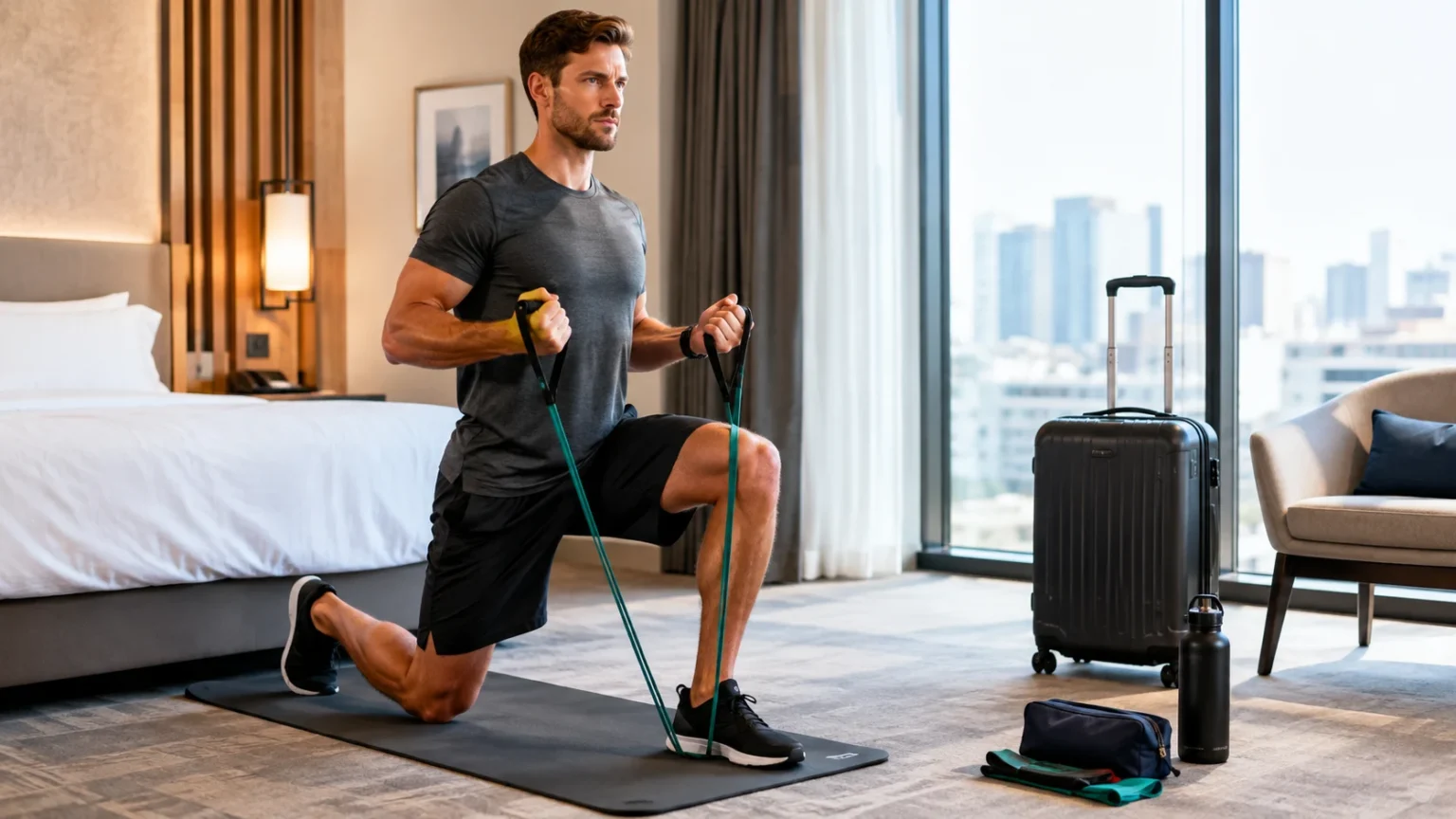
Best Travel Exercises Portable Enough for Any Trip
Travel can disrupt even the most consistent fitness routine. Long flights, unfamiliar hotels, packed itineraries, business meetings, and limited access to gyms can make regular exercise feel difficult. The good news is that staying active while traveling does not require a complete fitness center or a suitcase filled with workout equipment.
The best travel exercises are simple movements you can perform almost anywhere. Bodyweight squats, lunges, push-ups, glute bridges, planks, mobility drills, and resistance-band exercises can provide an effective workout in a hotel room, rental apartment, park, or other small space without taking much time.
Travel workouts are also useful because they can be adjusted around your schedule. You might complete a 10-minute mobility session after a flight, a 20-minute hotel workout before breakfast, or a short resistance-band routine between meetings. The goal is not always to reproduce your normal gym program perfectly.
Instead, focus on maintaining movement, strength, mobility, and consistency while you are away. Whether you travel for business, vacation, backpacking, or family visits, a small collection of portable exercises can help you stay active without making fitness dominate the entire trip.
Why Exercise Matters When You Travel
Travel often involves more sitting than an ordinary day. Time spent on airplanes, trains, buses, cars, airport lounges, and hotel rooms can quickly accumulate, particularly during long-distance journeys. Adding movement throughout the day can help break up those extended periods of inactivity.
Exercise can also help you maintain the routine you worked hard to build at home. Missing a few workouts during a vacation is not a problem, but some people find that completely abandoning their normal movement habits makes it harder to restart once the trip ends.
Short workouts can also provide structure during unpredictable travel days. Even when sightseeing, dining, and transportation schedules change unexpectedly, a 10- or 15-minute session can fit into a small window without requiring reservations, special facilities, or extensive preparation.
Most importantly, travel exercise should support the trip rather than interfere with it. You do not need to train at maximum intensity every morning. Walking through a new city, hiking, swimming, cycling, or exploring actively can also contribute to your overall physical activity.
What Makes a Good Travel Exercise?
A good travel exercise should require little or no equipment. Movements that depend on heavy machines or large weights are difficult to maintain consistently when you do not know what facilities will be available at your destination.
It should also work in a relatively small area. Hotel rooms can be narrow, crowded with furniture, or located above other guests, so exercises requiring large jumps or long running distances are not always practical. Controlled bodyweight movements are usually easier to adapt.
Travel exercises should be scalable as well. A beginner may perform a wall push-up while an experienced traveler performs standard or decline push-ups. The same principle applies to squats, lunges, planks, resistance-band exercises, and other portable movements.
Finally, good travel workouts should be efficient. When you have an entire city to explore or meetings to attend, spending two hours exercising may not be realistic. A well-designed short routine can train multiple muscle groups without consuming a large portion of the day.
Bodyweight Squats: The Essential Travel Exercise
Bodyweight squats are one of the most useful exercises for travel because they require no equipment and very little floor space. They primarily challenge the muscles of the lower body while also asking your core and trunk to stabilize your position.
Stand with your feet in a comfortable stance and lower your hips as though sitting toward a chair. Keep your movement controlled and descend only as far as you can comfortably manage while maintaining good balance and alignment.
You can make squats easier by using a chair or bed edge as a target. More experienced exercisers can increase the challenge by slowing the lowering phase, pausing near the bottom, adding repetitions, or progressing to split-squat variations.
Squats fit easily into hotel workouts because they are relatively quiet and adaptable. You can perform several sets in a small room without disturbing other guests with repeated jumping, making them a practical foundation for almost any travel routine.
Reverse Lunges for Strength and Balance
Reverse lunges train the legs while adding a balance and coordination challenge. They are particularly convenient for travel because stepping backward generally requires less forward space than walking lunges and can be performed beside a bed or desk.
Begin standing upright, step one foot backward, and lower yourself under control. Keep the front foot planted and use the front leg to return to standing. Alternate sides or complete several repetitions on one leg before changing.
If balance is difficult, place one hand lightly against a wall, chair, or sturdy desk. Support is perfectly acceptable, especially when you are tired from travel or performing the exercise in an unfamiliar environment.
To make reverse lunges harder, slow the movement, add a pause, increase repetitions, or hold a backpack containing a manageable amount of weight. Avoid using unstable luggage or objects that are difficult to grip safely.
Glute Bridges for Long Travel Days
Glute bridges can be particularly appealing after a day involving extended sitting. The exercise trains the glutes and surrounding hip muscles while requiring only enough floor space to lie comfortably on your back.
Lie down with your knees bent and feet planted on the floor. Gently brace your trunk, press through your feet, and raise your hips until your body forms a comfortable line from shoulders toward knees.
Pause briefly at the top without excessively arching your lower back, then lower your hips under control. Focus on smooth repetitions rather than trying to lift your hips as high as physically possible.
If the hotel floor is uncomfortable, use an exercise mat or another appropriate clean surface. Travelers can progress the movement with pauses, slower repetitions, or single-leg variations once the standard exercise feels easy and stable.
Push-Ups for Portable Upper-Body Training
Push-ups are one of the simplest ways to train the chest, shoulders, arms, and trunk without gym equipment. The exercise can be adapted to almost any fitness level, making it especially useful when you cannot predict what equipment your accommodation will provide.
Traditional push-ups begin in a high-plank position with the hands placed firmly on the floor. Lower your body under control while maintaining a stable trunk, then press through your hands to return to the starting position.
If standard push-ups are too difficult, use a sturdy wall or stable elevated surface. Wall push-ups and incline push-ups reduce the amount of bodyweight you need to move while preserving the basic pushing pattern.
Experienced exercisers can slow the lowering phase, add pauses, or increase repetitions rather than immediately searching for complicated variations. Good control usually provides more value than performing difficult versions with poor technique.
Planks for Core Strength Anywhere
Planks are popular travel exercises because they require minimal space and no specialized equipment. Rather than repeatedly bending the spine, a plank challenges the trunk to maintain a stable position against gravity.
Begin on your forearms or hands with your body supported between your upper body and feet. Keep your body comfortably aligned and avoid allowing the hips to collapse toward the floor or rise unnecessarily high.
You do not need to hold a plank for several minutes. Shorter controlled holds can be effective, particularly if you maintain good technique. Stop the set when your position starts deteriorating instead of extending the timer at all costs.
Side planks can add variety and emphasize lateral trunk stability. Beginners may use a bent-knee version, while more experienced travelers can perform the movement with the legs extended depending on comfort and ability.
Bird Dogs for Core Control and Mobility
Bird dogs combine trunk stability with coordinated movement of the arms and legs. They are useful when traveling because the movement is low impact, relatively quiet, and easy to perform in a hotel room.
Begin on your hands and knees with your spine in a comfortable neutral position. Slowly extend one arm forward while extending the opposite leg backward, keeping your trunk as steady as possible.
Return to the starting position and switch sides. Move deliberately rather than trying to reach as far as possible. The challenge comes from maintaining control while the limbs move, not from maximizing range at any cost.
Bird dogs work particularly well in a morning mobility routine or as part of a lower-intensity travel workout. They can also be paired with glute bridges, planks, and controlled bodyweight exercises for a quiet hotel-room circuit.
Calf Raises for Flights and Road Trips
Calf raises are an extremely portable exercise because they can be performed while standing almost anywhere. They train the calf muscles and introduce movement after long periods of sitting during flights, train rides, or road trips.
Stand upright with your feet comfortably positioned and slowly rise onto the balls of your feet. Pause briefly at the top before lowering your heels back toward the floor in a controlled manner.
Use a wall, chair, or other stable surface for balance if necessary. You can complete both legs together or progress toward single-leg calf raises once the standard version becomes easy.
Calf raises should not be treated as a medical solution for circulation problems or blood clots during travel. Travelers with individual health risks should follow advice from an appropriate healthcare professional regarding long-distance travel and movement.
Wall Sits for a Quiet Hotel Workout
Wall sits allow you to challenge the thighs without jumping, running, or using equipment. This makes them particularly useful in hotels where you want to exercise without creating significant impact noise for guests below you.
Stand with your back against a clear, sturdy wall and gradually slide downward until you reach a comfortable position. Your knees do not need to reach an exact angle if that creates discomfort.
Hold the position while breathing normally, then stand up when your legs become fatigued or your form begins to deteriorate. Beginners can start with relatively short holds and increase the duration gradually.
Wall sits can be combined with push-ups, calf raises, planks, and glute bridges to create a complete quiet workout. Because the exercise is isometric, it also provides a different training challenge from repeated squats and lunges.
Resistance-Band Rows for Your Back
Resistance bands are among the most useful pieces of portable workout equipment. A lightweight band can fit inside a small travel bag while providing options for training muscles that are harder to target with bodyweight movements alone.
Rows are particularly helpful because hotel workouts often contain plenty of pushing movements but fewer pulling exercises. Depending on the type of band and safe anchoring options available, rows can train the upper back and arms.
Always follow the manufacturer’s instructions for anchoring and inspect the band for damage before use. Do not attach resistance bands to furniture, handles, or objects that could move, break, or create an unsafe setup.
If you regularly travel, consider building a short resistance-band workout around rows, presses, lateral movements, and lower-body exercises. A small band can provide significantly more exercise variety without adding much weight to your luggage.
Resistance-Band Lateral Walks
Small loop resistance bands are particularly convenient for travel because they occupy almost no luggage space. Lateral band walks can challenge muscles around the hips and provide a useful addition to bodyweight lower-body training.
Place the band according to the product’s instructions, adopt a stable stance, and take controlled steps to the side while maintaining tension. Avoid allowing your feet to snap together after each step.
You do not need a large room. Several small steps in one direction followed by several steps back can work in a hotel room, hallway-sized area, or other limited space.
Band tension should be challenging without forcing you to distort your posture. If you cannot control each step, choose a lighter band or reduce the distance rather than prioritizing resistance over movement quality.
Walking: The Most Underrated Travel Workout
Walking may be the easiest travel exercise of all because it can become part of the trip itself. Exploring neighborhoods, museums, markets, parks, waterfronts, and historic districts on foot can add significant movement without requiring a separate workout session.
You can also make walking more intentional. Take a brisk walk before breakfast, walk short distances instead of automatically using transportation, or explore a nearby park when you have free time between scheduled activities.
Walking has another advantage: it allows you to experience your destination. A hotel gym may look similar anywhere in the world, whereas walking allows you to observe local architecture, street life, shops, landscapes, and neighborhoods.
Safety should always guide your choice of route. Check local conditions, weather, lighting, traffic, and neighborhood guidance before exploring unfamiliar areas, particularly when walking alone or very early or late in the day.
Stair Climbing When No Gym Is Available
Stairs can provide a convenient cardiovascular and lower-body challenge when safe access is available. Hotels, office buildings, stations, and public areas often contain staircases that can add extra movement to an otherwise sedentary travel day.
Simply choosing stairs instead of elevators for manageable distances can increase everyday activity. You do not need to turn every staircase into a high-intensity workout for the movement to contribute to an active day.
If you intentionally use stairs for exercise, move at a pace you can control and pay attention to other people using the space. Avoid sprinting through crowded or poorly lit staircases where a fall could occur.
Travelers with joint problems, balance difficulties, or other relevant health limitations may prefer walking on level ground or another suitable activity. Exercise should always be adapted to the person rather than forcing every traveler into the same routine.
Standing Mobility Exercises After Sitting
Mobility work is especially useful after long periods in cars, airplanes, trains, or conference rooms. Gentle movement can help you transition from sitting into activity without immediately demanding an intense workout from a body that has been relatively still.
Simple options include controlled shoulder circles, gentle trunk rotations, ankle movements, hip circles, and comfortable reaching patterns. Keep movements smooth and avoid forcing joints aggressively into ranges that feel painful.
You can also alternate between sitting and standing more often during travel when circumstances allow. Walking around during appropriate breaks, standing while waiting, or briefly changing position can reduce the feeling of being stuck in one posture for hours.
Mobility work does not need to resemble an elaborate stretching routine. A few minutes of controlled movement before sightseeing, hiking, or exercising may be enough to help you feel more prepared for the activities ahead.
A 10-Minute Hotel Room Workout
A short hotel workout can begin with approximately one minute of comfortable movement such as marching in place and easy mobility. The purpose is simply to transition from rest into exercise rather than jumping immediately into harder repetitions.
Next, perform a circuit of bodyweight squats, incline or standard push-ups, reverse lunges, glute bridges, and a plank. Choose repetitions or work periods you can perform with controlled technique and allow brief rests when necessary.
Complete one or more rounds depending on your available time, energy, and training experience. A beginner may find one carefully controlled circuit sufficient, while a more experienced traveler may repeat it several times.
Finish with easy walking around the room and gentle movement rather than collapsing immediately onto the bed. Ten minutes will not reproduce every part of a full gym workout, but it can maintain the habit on a busy travel day.
A 20-Minute Full-Body Travel Workout
When you have a little more time, begin with several minutes of easy movement. March in place, perform controlled squats, move your shoulders, and gradually increase your range rather than trying to become intensely warm immediately.
For the main workout, combine squats or split squats, push-ups, resistance-band rows if available, glute bridges, calf raises, and a core exercise. This provides a mixture of lower-body, upper-body, and trunk training.
Organize the movements into a circuit and repeat them according to your ability. Keep enough rest between exercises to maintain good form rather than turning the entire session into a competition against the clock.
A 20-minute session can be plenty during a vacation or business trip. If you are also walking extensively, hiking, swimming, or participating in other activities, your formal workout does not need to carry the entire burden of keeping you active.
A No-Jumping Workout for Hotel Rooms
Jumping exercises can be effective, but they are often a poor choice in hotel rooms because repeated impact may disturb the people staying below you. Fortunately, a challenging travel workout does not require burpees, jump squats, or running in place.
Choose slow squats, reverse lunges, push-ups, wall sits, glute bridges, calf raises, bird dogs, and planks instead. Slowing each repetition increases muscular effort without adding impact or requiring extra space.
Resistance bands can make a quiet workout even more versatile. Rows, lateral walks, presses, curls, and other appropriate movements allow you to increase resistance without repeatedly landing on the floor.
Quiet workouts are also useful when traveling with family or colleagues whose schedules differ from yours. You can exercise early in the morning without turning your room into a miniature high-impact fitness studio.
Best Exercises to Do on a Flight
Movement options on an airplane are naturally limited, and safety instructions from the crew should always take priority. When seated, simple ankle pumps, ankle circles, and gentle leg movements can provide an opportunity to move rather than remaining completely motionless.
When it is safe and permitted to leave your seat, occasional walking may help break up long periods of sitting. Do not stand or move through the cabin when the seatbelt sign is illuminated or when crew instructions require passengers to remain seated.
Avoid attempting complicated stretches in narrow aisles or areas where you could interfere with other passengers. Travel movement should remain practical and respectful of the limited shared environment.
People with increased health risks related to long-distance travel should seek individualized medical guidance rather than relying solely on generic exercise advice. Simple movement is useful, but personal medical circumstances can require specific precautions.
Best Exercises During Road Trips
Road trips can involve several consecutive hours of sitting, particularly when covering long distances. When practical, planned stops provide an opportunity to walk, use restrooms, drink water, and move before continuing the journey.
During breaks, try several minutes of comfortable walking followed by bodyweight squats, calf raises, or gentle mobility movements if the environment is safe. You do not need to perform a complete workout beside the car.
Passengers can also change their seated position periodically and move their ankles during longer journeys. The driver, however, should remain focused entirely on safe driving rather than attempting stretches or exercises that distract from vehicle control.
Travel exercise should fit naturally around safe rest breaks. Adding just a few minutes of movement whenever you stop can be more realistic than arriving exhausted at your destination and trying to complete a demanding workout immediately.
What Exercise Equipment Is Worth Packing?
A loop resistance band is one of the easiest pieces of fitness equipment to pack. It weighs very little, takes up minimal luggage space, and can add resistance to lower-body movements such as lateral walks and other suitable exercises.
A longer resistance band can provide even more options, particularly for upper-body training. Choose a product appropriate for your strength level and inspect it regularly because damaged bands can snap during exercise.
A lightweight travel exercise mat may be worthwhile if you drive to your destination or have generous luggage space. Air travelers with limited baggage, however, may find that carrying a full mat is unnecessary when many exercises can be performed standing.
You usually do not need dumbbells, kettlebells, or other heavy equipment unless your trip specifically involves training. The best portable fitness equipment earns its place in your luggage by offering multiple uses without adding significant size or weight.
How to Use a Backpack as Workout Resistance
A backpack can sometimes provide additional resistance for exercises when used carefully. You can place a manageable amount of clothing or other soft items inside and hold or wear the bag during certain controlled movements.
For example, a stable backpack can increase the difficulty of squats or split squats if the load is appropriate. Begin lighter than you think necessary because luggage weight can feel very different during repeated exercise movements.
Avoid filling the bag with breakable electronics, glass containers, or objects that can shift dangerously. Check the straps and closures before using a backpack for anything other than its normal purpose.
If the improvised resistance feels unstable or awkward, return to bodyweight exercises instead. Travel workouts should be simple and safe; creating complicated homemade equipment is unnecessary when slower repetitions and harder exercise variations can increase difficulty.
How to Stay Consistent With Exercise While Traveling
Set a smaller minimum goal than you normally use at home. If your regular routine involves an hour at the gym, expecting the same schedule during a packed vacation may create unnecessary frustration. A 10- or 20-minute travel workout can be a perfectly reasonable substitute.
Schedule movement around the most predictable part of your day. Morning often works because sightseeing, meetings, meals, and delays have not yet disrupted the schedule, but another consistent window may suit you better.
Keep your exercise clothes easy to access rather than buried at the bottom of your luggage. Small environmental choices reduce friction. When your shoes and resistance band are visible, beginning a short session requires less preparation.
Most importantly, avoid an all-or-nothing mindset. Walking for an hour while exploring a city still counts as movement even if you never perform your planned hotel workout. Travel fitness should support consistency, not create guilt whenever your routine changes.
Should You Exercise Every Day on Vacation?
You do not need to perform a formal workout every day simply because you are traveling. Rest remains part of a balanced exercise routine, and vacations often contain more physical activity than people realize through walking, swimming, hiking, carrying luggage, and sightseeing.
Consider your total activity rather than only counting scheduled workouts. A day involving several hours of walking through a city may already place significant demands on your legs, making an additional high-volume lower-body workout unnecessary.
Your travel plans should influence your exercise choices. Before a demanding hike, for example, a lighter mobility session may make more sense than completing dozens of squats and lunges the night before.
Flexibility helps make exercise sustainable. Maintain enough movement to feel good and preserve your habits, but allow the purpose of the trip to remain important. Fitness should fit into your travel experience rather than forcing every day to revolve around training.
Common Travel Workout Mistakes to Avoid
One common mistake is attempting to reproduce your entire home gym routine with inadequate equipment. Travel creates different conditions, so simplify your training instead of improvising unsafe substitutes for heavy weights or specialized machines.
Another mistake is performing intense workouts immediately after exhausting travel. Poor sleep, jet lag, dehydration, heat, altitude, and long journeys can change how you feel. Adjust your intensity according to your current condition rather than following your normal numbers automatically.
Travelers also sometimes ignore their surroundings. Slippery hotel floors, unstable furniture, crowded sidewalks, extreme temperatures, and unfamiliar neighborhoods can introduce risks that do not exist in your regular workout environment.
Finally, avoid believing that a short workout is pointless. Ten minutes of intentional movement can maintain your habit and add meaningful activity to the day. You can always do more when circumstances allow, but a smaller session is often better than continually waiting for perfect conditions.
How to Build Your Own Portable Travel Workout
Start by selecting one lower-body exercise such as squats, reverse lunges, or split squats. Choose a version appropriate for your ability and the amount of space available in your accommodation.
Next, include an upper-body pushing movement such as wall, incline, or standard push-ups. If you packed a resistance band and have an appropriate safe setup, add a pulling exercise such as a row to create better upper-body balance.
Add a hip-focused movement such as a glute bridge and a core exercise such as a plank, side plank, or bird dog. This gives you a compact group of exercises covering several major movement patterns.
Complete the movements as a circuit, resting when needed, and repeat according to your time and fitness level. A simple routine that you actually perform is more valuable during travel than an elaborate workout plan that requires equipment you never find.
Final Thoughts on the Best Travel Exercises
The best travel exercises are not necessarily the most complicated or intense movements. They are exercises you can perform safely, consistently, and conveniently regardless of whether you are staying in a luxury hotel, rental apartment, family home, or small roadside room.
Bodyweight squats, reverse lunges, push-ups, planks, glute bridges, bird dogs, calf raises, walking, and resistance-band exercises provide plenty of options for portable workouts. Most require little more than enough room to move comfortably.
Remember that staying active while traveling does not mean maintaining your normal routine perfectly. Walking through a new destination, taking the stairs, hiking, swimming, and moving during appropriate travel breaks can all contribute to an active trip.
Pack light, keep your workout simple, and adjust according to your schedule and energy. When exercise becomes flexible enough to travel with you, missing access to your normal gym no longer has to mean abandoning movement until you return home.
Frequently Asked Questions
What are the best exercises to do while traveling?
Squats, lunges, push-ups, planks, glute bridges, bird dogs, calf raises, walking, and resistance-band exercises are excellent portable options because they require little equipment.
Can I get a good workout in a hotel room?
Yes. A full-body hotel workout can combine lower-body exercises, push-ups, core movements, and resistance-band exercises in 10 to 30 minutes without requiring a gym.
What fitness equipment should I pack for travel?
A small resistance band or loop band is usually enough for most travelers. It takes up very little luggage space and can add resistance to several upper- and lower-body exercises.
Is walking enough exercise on vacation?
Walking can contribute substantially to your overall activity, especially during sightseeing-heavy trips. Whether you need additional workouts depends on your goals, activity level, and the rest of your routine.
How do I stay fit while traveling without a gym?
Use short bodyweight workouts, walk whenever practical, take stairs when appropriate, pack a resistance band, and focus on consistency rather than trying to duplicate your complete gym routine.