





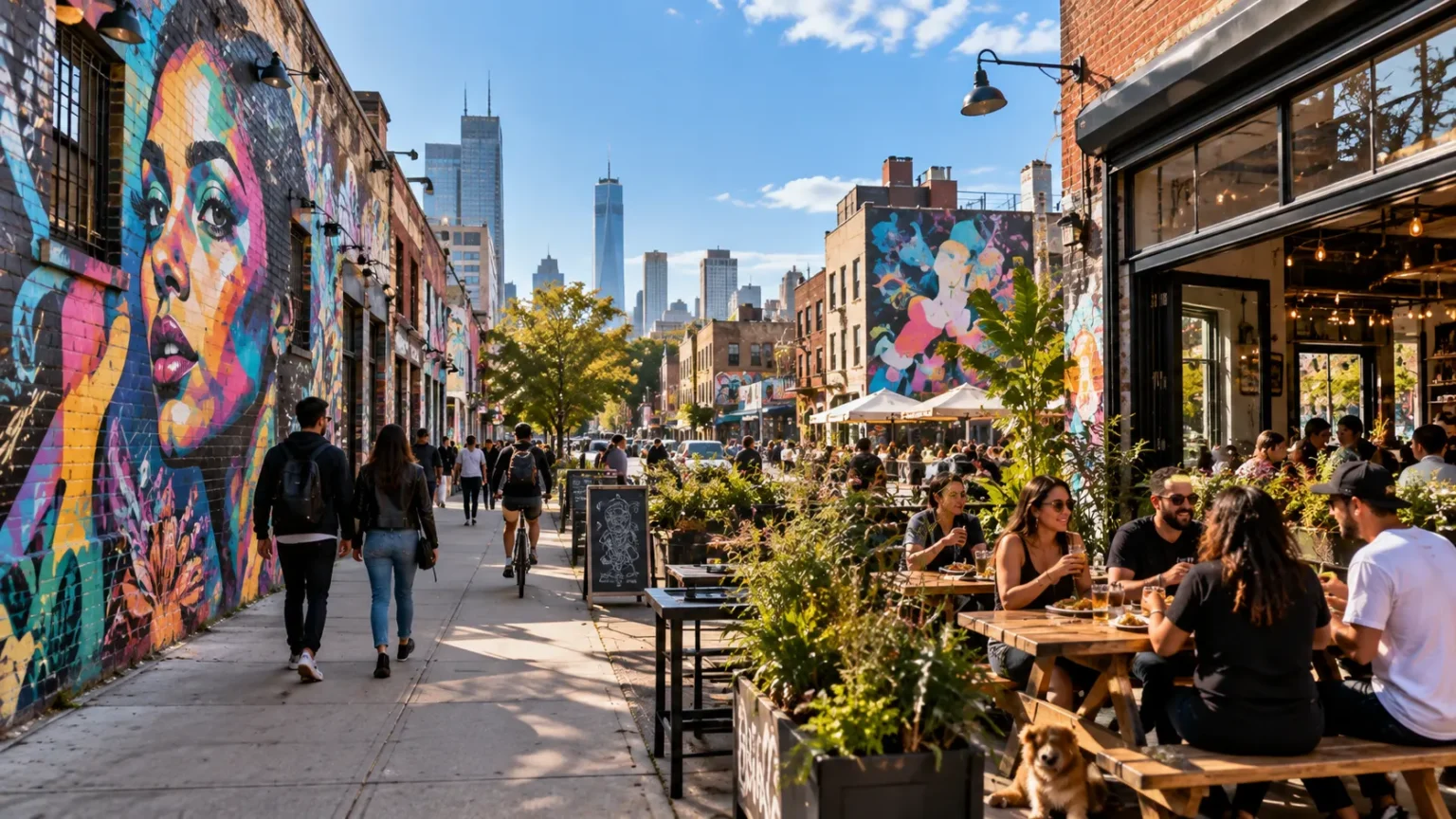
Bushwick, Brooklyn Guide: Art, Food & Things to Do
Bushwick, Brooklyn is one of New York City’s most visually distinctive neighborhoods, known for colorful street murals, independent restaurants, creative nightlife, converted industrial buildings, vintage shops, cafés, and a strong mix of long-standing local communities and newer creative businesses. Located in northern Brooklyn near Williamsburg, Bedford-Stuyvesant, and Ridgewood, Bushwick feels noticeably different from the polished streets many first-time visitors associate with Manhattan. Warehouses sit beside residential blocks, giant murals cover brick walls, and small restaurants can appear in places that look almost anonymous from the street. Puerto Rican, Dominican, Mexican, and other Latino communities have played an important role in shaping the neighborhood. Today, artists, musicians, designers, restaurateurs, and nightlife communities add another layer to its identity.
One of Bushwick’s biggest attractions is that exploring the neighborhood does not have to revolve around traditional tourist landmarks. Much of the experience comes from walking slowly, looking at murals, stopping for coffee, noticing independent shops, trying food from different cultures, and seeing how industrial spaces have been reused. The neighborhood rewards visitors who leave enough time to wander rather than arriving with a minute-by-minute checklist. Street art around Troutman Street provides an obvious starting point, while Maria Hernandez Park offers a completely different view of everyday neighborhood life. Food ranges from pizza and tacos to Ethiopian dishes, seafood, bakeries, and inventive contemporary cooking. After dark, music venues, dance spaces, bars, and late-night restaurants give Bushwick another personality.
A Bushwick Brooklyn itinerary can work as a half-day outing, a full day of exploring, or part of a wider trip through northern Brooklyn and nearby Queens. Comfortable walking shoes are useful because many of the most interesting details appear between destinations rather than directly beside subway entrances. Visitors should also remember that Bushwick is a real residential neighborhood rather than an outdoor entertainment park, so respecting homes, businesses, artists, and longtime residents matters. Street art changes over time, restaurants open and close, and nightlife calendars vary from week to week. That constant change is part of what makes Bushwick interesting. This guide explains the neighborhood’s art, food, attractions, nightlife, shopping, transportation, safety, and how to plan a memorable day.
Why Bushwick Is Worth Visiting
Bushwick appeals to travelers who want to experience a side of New York that feels creative, unpredictable, and less centered around conventional sightseeing. Unlike neighborhoods where major attractions dictate where visitors walk, Bushwick encourages exploration at street level. A plain industrial building may reveal a huge mural around the corner, while an unassuming storefront can contain a busy restaurant, gallery, record shop, or café. The contrast between residential streets, warehouses, elevated train structures, and artistic spaces gives the neighborhood much of its visual character. Photographers particularly enjoy the textures, colors, signs, architecture, and constantly changing walls. Even a casual walk can feel different from the carefully planned atmosphere of more tourist-heavy parts of the city.
The neighborhood’s history also makes Bushwick more complex than the shorthand description of an “arts district.” Long before the current wave of galleries, bars, and creative businesses, Bushwick was shaped by generations of working-class New Yorkers and immigrant communities. Puerto Rican residents became especially influential in the neighborhood during the twentieth century, while Dominican, Mexican, Ecuadorian, and other Latino communities contribute strongly to Bushwick today. This heritage remains visible in restaurants, grocery stores, churches, community organizations, murals, music, and everyday street life. Visitors gain a better experience when they recognize that creative change exists alongside deeper neighborhood history. Treating Bushwick only as a trendy backdrop misses much of what actually makes it distinctive.
Bushwick’s industrial architecture is another reason the neighborhood became attractive to creative communities. Large former factories, workshops, garages, and warehouses provided spaces that could be adapted for studios, performances, restaurants, galleries, and nightlife. Some buildings still serve industrial purposes, while others now host completely different activities behind their brick façades. This mix gives Bushwick a rougher visual character than brownstone neighborhoods elsewhere in Brooklyn. Loading doors, roll-down gates, painted walls, rooftop structures, and old manufacturing buildings form part of the streetscape. Visitors interested in urban design can spend almost as much time examining the buildings as the artwork painted on them. The neighborhood’s identity is tied closely to this constant reuse of space.
Another attraction is Bushwick’s relatively independent character. Large national chains exist around the neighborhood, but many visitors come specifically for locally run restaurants, cafés, bars, shops, studios, and creative projects. That makes a day in Bushwick feel more discovery-oriented than a visit built entirely around famous brands. Menus can be experimental, shop inventories can be highly specific, and nightlife events often reflect niche music or performance communities. The result is not a single unified “Bushwick style,” but rather an unusually wide collection of small scenes operating near one another. Travelers who enjoy independent businesses generally have more to explore than those looking primarily for luxury shopping or famous monuments.
Bushwick is also conveniently positioned for combining with other neighborhoods. Williamsburg lies to the northwest, Bedford-Stuyvesant borders Bushwick to the south and west, and Ridgewood sits immediately across the Brooklyn-Queens boundary. Each area has its own architecture, food, nightlife, and cultural history, making northern Brooklyn and western Queens excellent territory for travelers who enjoy neighborhood-based exploration. However, Bushwick itself covers a sizable area, so trying to see it while rushing between several other districts can reduce the experience. Giving the neighborhood several unhurried hours makes it easier to notice smaller details. For first-time visitors, a full afternoon followed by dinner and nightlife often provides the most satisfying introduction.
Explore Bushwick’s Street Art and Creative Culture
Street art is one of the primary reasons travelers seek out Bushwick, and the mural-covered blocks around Troutman Street provide the most concentrated introduction. The Bushwick Collective helped turn numerous industrial walls into an evolving outdoor gallery featuring artists from New York and around the world. Large portraits, lettering, abstract work, surreal imagery, graphic characters, and politically or socially influenced pieces can all appear within a relatively compact area. Because murals are replaced and repainted, photographs from an older travel guide may no longer match what visitors encounter. That changing quality is part of the attraction. Instead of visiting a static museum collection, you are walking through an outdoor art environment that continues to evolve.
A good street-art walk should extend beyond the most photographed walls. Troutman Street, St. Nicholas Avenue, Wyckoff Avenue, Jefferson Street, and nearby industrial blocks can all reward slower exploration, while smaller pieces appear on shutters, side walls, loading doors, and unexpected corners. Some artworks are commissioned murals, while others belong to broader graffiti and street-art traditions with different histories and rules. Visitors do not need expert knowledge to enjoy them, but recognizing that not every painted wall belongs to the same project adds useful context. Look closely at signatures and artist handles when they are visible. Discovering the artist behind a favorite piece can turn a casual photograph into a deeper appreciation of the work.
Photography is popular around the murals, particularly on bright days when saturated colors stand out against brick and concrete. Morning can provide softer light and fewer people, while late afternoon creates more dramatic shadows across industrial streets. A wide-angle phone camera is useful for enormous walls when narrow sidewalks make stepping backward difficult. Portrait photographers should remain aware that businesses, residents, delivery workers, and traffic continue using these streets. Blocking garage doors or standing in the roadway for a photograph creates unnecessary problems. The most respectful approach is to treat the artwork as part of an active neighborhood rather than as a private photo set.
Bushwick’s creative culture extends beyond murals into galleries, studios, performance spaces, music, design, fashion, and temporary events. Exhibitions can appear in small independent spaces or buildings that look almost invisible from outside. Open-studio weekends, pop-up markets, performances, and neighborhood art events occasionally make it possible to see work that would be difficult to encounter during an ordinary walk. Event schedules change frequently, so visitors interested in contemporary art should check what is happening shortly before their trip. The advantage of this changing calendar is that repeat visits rarely feel identical. Bushwick’s cultural energy is less about one permanent institution and more about the accumulation of independent creative projects.
The neighborhood is also a useful place to think about the relationship between street art and urban change. Murals can beautify buildings and attract visitors, but popular art districts can also become connected with rising rents, changing businesses, and pressure on longtime residents. Bushwick’s evolution therefore contains both creative opportunity and complicated questions about development and gentrification. Visitors do not need to solve those issues during a weekend trip, but acknowledging them creates a more people-first understanding of the neighborhood. Supporting a range of local restaurants and shops rather than only viral destinations can help broaden where visitor spending goes. Art becomes more meaningful when it is viewed within the community surrounding it.
What to Eat in Bushwick
Bushwick’s food scene is one of the strongest reasons to plan more than a quick street-art visit. The neighborhood offers an unusually broad mix of casual food, destination restaurants, cafés, bakeries, bars with serious kitchens, and family-run establishments reflecting local immigrant communities. Pizza remains one of the best-known categories, with Roberta’s becoming closely associated with Bushwick’s modern restaurant reputation. However, stopping at pizza alone gives an incomplete picture of the neighborhood. Mexican food, Caribbean cooking, Ethiopian dishes, seafood, sandwiches, pastries, vegetarian meals, and contemporary American menus all deserve attention. Eating throughout the day rather than choosing only one large dinner can be an effective way to experience more of Bushwick’s culinary variety.
For breakfast or brunch, Bushwick works well for travelers who prefer relaxed cafés over formal hotel dining rooms. Coffee shops throughout the neighborhood serve espresso drinks, pastries, breakfast sandwiches, and lighter meals that fit naturally into a walking itinerary. Starting near the Jefferson Street or DeKalb Avenue area makes it easy to eat before exploring the murals. Weekend brunch can become crowded at popular restaurants, so arriving earlier often creates a calmer start. Visitors planning a full food-focused day should keep breakfast relatively light because there are many opportunities for snacks later. A coffee stop can also provide a useful break during hot summer or cold winter weather.
Lunch is a good time to explore Bushwick’s Mexican and Latin American food. Tacos, tortas, tamales, pupusas, grilled meats, rice dishes, bakeries, and other casual options appear throughout Bushwick rather than being limited to a single restaurant zone. Travelers should pay attention to neighborhood establishments filled with regular customers rather than judging restaurants only by social-media visibility. Menus may be inexpensive compared with destination dining elsewhere in New York, although prices vary widely. Cash can still be useful at smaller businesses, even though card payments are increasingly common. Trying something quick for lunch leaves enough time for murals, shops, and park wandering before dinner.
Dinner can range from simple pizza to a more deliberate sit-down meal. Roberta’s remains a recognizable Bushwick name for travelers interested in wood-fired pizza, while other restaurants offer seafood, handmade pasta, Ethiopian food, plant-based menus, and chef-driven small plates. Sea Wolf provides another casual neighborhood option for seafood-oriented diners. Reservations can be useful for popular dinner spots, especially on Friday and Saturday nights, but plenty of casual places allow spontaneous meals. The best choice depends on whether dinner is the main event or simply the transition into nightlife. Visitors heading to a late show may prefer eating earlier so they are not rushing through a meal.
Bushwick also rewards people who leave room for late-night food. The neighborhood’s nightlife schedule means restaurants, food counters, and casual kitchens can remain relevant well after conventional dinner hours. Pizza slices, tacos, sandwiches, and other straightforward food often taste particularly useful after hours of dancing or walking. Still, opening hours change, and not every kitchen operates as late as the attached bar or venue. Checking the day’s hours before assuming food will be available at midnight is sensible. Travelers with dietary restrictions should research several options in advance rather than relying on one restaurant. Bushwick’s variety makes vegetarian and vegan eating relatively easy, but individual menus can change.
Best Things to Do in Bushwick During the Day
After exploring the main mural zone, Maria Hernandez Park provides one of the best places to slow down and see a more everyday side of Bushwick. The park functions as a neighborhood gathering place with lawns, paths, recreation areas, a playground, and spaces used by residents throughout the day. On warm weekends it can feel especially lively, with families, friends, dog walkers, athletes, and vendors sharing the area. Sitting here for twenty or thirty minutes provides a useful contrast with photographing industrial murals. Travelers sometimes rush from attraction to attraction and miss the ordinary public spaces that reveal how neighborhoods actually function. Maria Hernandez Park helps correct that tendency.
Walking itself is another worthwhile Bushwick activity because architecture and street life change noticeably from block to block. Around the mural area, warehouses and former industrial structures dominate many views, while other streets transition quickly into lower-scale residential buildings. Elevated subway structures create another visual layer in parts of the neighborhood, especially around major commercial corridors. Old signs, painted storefronts, community gardens, churches, small businesses, and new construction all appear within relatively short distances. Rather than following only one main avenue, occasionally turning onto a quieter side street can reveal a different Bushwick. Visitors should simply remain mindful that these are residential blocks and avoid treating private stoops or entrances as attractions.
Thrift shopping and vintage browsing also fit naturally into a daytime Bushwick itinerary. The neighborhood and its surrounding area have become known for secondhand clothing, independent fashion, vintage pieces, records, books, art objects, and unusual household finds. Inventory changes constantly, which is part of the appeal for shoppers who enjoy searching rather than arriving for one predetermined item. Prices vary from genuinely inexpensive secondhand finds to carefully curated vintage pieces carrying premium prices. Set a budget before browsing if vintage clothing tends to become an impulse purchase. Even visitors who do not buy anything can enjoy seeing how Bushwick’s fashion culture connects with its music and nightlife scenes.
Travelers interested in food can turn daytime exploration into an informal tasting tour. Instead of sitting down for three full meals, share a slice of pizza, stop for a pastry, try a taco, drink coffee, and save room for dinner. This approach works particularly well for couples or groups because several people can split dishes without becoming full too early. Walking between stops also provides more opportunities to see murals and shops. Avoid scheduling every food stop in advance, since one of Bushwick’s strengths is discovering something appealing unexpectedly. Keeping one or two priority places alongside room for improvisation creates a better balance.
Daytime is also useful for travelers who are interested in Bushwick but not especially attracted to late-night club culture. Street art, photography, coffee, parks, shopping, architecture, and food can easily fill six or seven hours without entering a single bar. Families visiting with older children or teenagers may find the mural district particularly engaging because the visual experience is immediate and outdoors. Younger children may enjoy the park but can become tired during long stretches of industrial walking. Summer heat and winter cold also affect how much walking feels realistic. Structuring the day around periodic indoor breaks makes Bushwick enjoyable across more seasons.
Bushwick Nightlife, Music and After-Dark Culture
Bushwick’s nightlife is one of the neighborhood’s defining features, particularly for visitors interested in DJs, electronic music, live performances, queer nightlife, alternative events, and late-night dancing. The scene is distributed across bars, clubs, converted warehouses, music venues, and spaces that combine several functions under one roof. Some nights are centered around well-known touring performers, while others feature local DJs or experimental events. Bushwick nightlife tends to begin later than many visitors expect, so a venue that seems quiet at 9 p.m. may feel completely different several hours later. Checking event calendars is more useful than simply choosing a venue based on daytime appearance. The specific party or performer often matters as much as the space itself.
Mood Ring represents the kind of nightlife venue associated with Bushwick’s creative social culture, combining drinks, DJs, dancing, and a distinctive atmosphere. Other bars lean more toward cocktails, neighborhood socializing, live music, or intimate dance floors. Visitors do not need to spend the entire night in one venue because several options may be within walking or short rideshare distance of one another. However, Bushwick covers a large area, so assuming every nightlife location is five minutes away can create unnecessary late-night walking. Check addresses before beginning the evening. Planning one main event and leaving the rest flexible usually works better than trying to visit five venues.
Queer nightlife has an especially visible place within Bushwick and nearby northern Brooklyn. Drag performances, dance parties, themed nights, and LGBTQ+ events contribute strongly to the neighborhood’s after-dark identity. These spaces often emphasize self-expression, creative fashion, and inclusive social environments rather than conventional nightclub aesthetics. Visitors should still check the identity and expectations of an individual event rather than assuming every party has the same atmosphere. Some nights are ticketed and may sell out, while others operate more casually. Respecting the culture of the space is more important than arriving simply because a venue has become famous online.
Live music provides an alternative for travelers who want nightlife without committing to a large dance party. Bushwick and surrounding neighborhoods regularly host rock, punk, electronic, experimental, indie, metal, and mixed-format events. Venue lineups change constantly, making the neighborhood particularly rewarding for travelers willing to check schedules close to their visit. A performer you have never heard of can sometimes produce a more memorable evening than a heavily planned headline show. Ear protection is worth carrying if loud music is likely. Small reusable earplugs take almost no space and can make long nights considerably more comfortable.
Getting home deserves advance thought because Bushwick nightlife can continue until very late. The subway operates around the clock, but overnight service can involve longer waits, construction changes, or altered routes. Check real-time transit information before leaving a venue rather than assuming daytime service patterns still apply. Rideshares and taxis provide alternatives, particularly for groups or travelers staying far from the subway. Avoid becoming so intoxicated that navigating an unfamiliar neighborhood becomes difficult. Bushwick can be an exciting place after dark, but the same practical habits used anywhere in New York—staying aware, keeping belongings secure, and planning transportation—remain important.
Shopping, Coffee and Slow Neighborhood Wandering
Bushwick’s café culture fits naturally with a neighborhood built around freelancers, artists, remote workers, students, and creative businesses. Coffee shops range from compact espresso counters to larger spaces where people spend an hour working or meeting friends. For visitors, cafés serve another useful role by breaking a long walking day into manageable sections. A morning coffee can come before the murals, while an afternoon stop provides a chance to rest, recharge a phone, and reorganize the evening plan. Not every café welcomes long laptop sessions during busy hours, so pay attention to the atmosphere. Travelers usually need only enough time for a drink and short break.
Vintage and secondhand clothing are among the most characteristic shopping categories in and around Bushwick. Stores may carry everything from inexpensive used basics to carefully selected designer items, workwear, streetwear, accessories, and clothing from previous decades. The experience rewards patience because inventory is less predictable than conventional retail. Sizing can also vary dramatically across older pieces, making trying things on worthwhile when possible. Shoppers searching for one specific item may leave disappointed, while people open to unexpected finds tend to enjoy the process more. Bringing a reusable tote makes small purchases easier during a walking day.
Record shopping connects naturally with Bushwick’s nightlife and music culture. Independent stores and music-focused spaces in northern Brooklyn often carry vinyl across electronic, rock, hip-hop, experimental, jazz, and niche genres. Browsing records can provide a slower alternative to the sensory intensity of murals and busy restaurants. Visitors traveling by plane should remember that vinyl becomes heavy quickly, particularly when several purchases accumulate. Packaging matters as well because records can warp or become damaged in poorly packed luggage. One memorable release can make a better travel souvenir than buying a large stack simply because the store feels exciting.
Independent markets and pop-up events can add another dimension to shopping. Depending on the weekend, visitors may find local designers, handmade jewelry, prints, vintage sellers, ceramics, food vendors, or small fashion labels appearing in temporary markets and event spaces. These events are difficult to build into an evergreen itinerary because dates change frequently, but checking neighborhood event calendars shortly before visiting can reveal worthwhile additions. Pop-ups are particularly useful for travelers who want to buy directly from local makers rather than conventional souvenir stores. Prices may be higher than mass-produced items because the products are often handmade or produced in smaller quantities.
The most enjoyable Bushwick shopping strategy is usually to treat stores as part of the walk rather than turning the day into a strict retail route. A mural may lead you toward a coffee shop, which leads toward a vintage store, which places you near a restaurant you had not planned to visit. That kind of flexible movement suits Bushwick better than attempting to optimize every block. Save locations you definitely want to see on a map, but leave enough gaps for discoveries. Carrying a portable battery helps because photography, navigation, and searching opening hours can drain a phone quickly. A little flexibility often produces the most memorable parts of the day.
Getting to Bushwick, Best Time to Visit and Safety Tips
The L train is one of the most useful subway lines for reaching central parts of Bushwick from Manhattan and Williamsburg. Jefferson Street and DeKalb Avenue are convenient stations for the street-art, park, restaurant, and nightlife areas many first-time visitors want to explore. Other parts of Bushwick are served by additional subway routes, including the M, J, and Z depending on the destination. Because the neighborhood is geographically large, choosing the station closest to your first activity can save considerable walking. Do not simply enter “Bushwick” into a navigation app and accept whichever point appears. Search for the actual destination or intersection you plan to visit.
Bushwick is walkable once you reach the section you want to explore, but distances can be deceptive. What looks like a single neighborhood on a map can require twenty or thirty minutes of walking between widely separated venues. Comfortable shoes are therefore more useful than fashionable footwear that becomes painful after several miles. Buses can help connect areas not positioned conveniently along the same subway route. Bikes and rideshares are additional options, although visitors unfamiliar with New York traffic should be cautious about cycling. For most first-time travelers, subway plus walking remains the simplest combination.
Spring and fall are especially comfortable seasons for exploring Bushwick because much of the experience takes place outdoors. Mild temperatures make mural walks, park stops, and neighborhood wandering easier than during extremely hot or cold weather. Summer creates lively streets and active nightlife but can become humid, with relatively little shade on some industrial blocks. Winter offers fewer crowds and can make cafés or restaurants feel especially inviting, although long outdoor art walks require warm clothing. Rain does not necessarily ruin a Bushwick visit because food, shopping, cafés, and indoor cultural events can fill several hours. Street-art photography simply becomes less predictable in poor weather.
Bushwick is generally visited safely by large numbers of residents, New Yorkers, and travelers, but it remains an urban neighborhood where normal city awareness is appropriate. Keep phones and wallets secure, particularly in crowded bars, clubs, trains, and nightlife environments. At night, stick to reasonably active routes when walking alone and use navigation if you are unsure where you are going. Do not enter abandoned-looking buildings, fenced industrial properties, rooftops, or private areas in pursuit of photographs. Some quieter blocks can feel very different late at night than they do in the afternoon. If a route feels uncomfortable, taking a rideshare or moving toward a busier street is reasonable.
Visitors should also approach the neighborhood respectfully. Ask before photographing individuals closely, avoid blocking residential entrances, and remember that murals painted on business walls do not make surrounding property public. Keep noise reasonable on residential blocks after leaving nightlife venues. Supporting local businesses across different parts of Bushwick is preferable to treating the area as a checklist of Instagram locations. Learning a little about the neighborhood’s Latino and working-class history also provides more context for the changes visible today. The best Bushwick visit combines curiosity with awareness that the neighborhood exists for its residents every day, not only for visitors seeking art and nightlife.
A One-Day Bushwick Itinerary for First-Time Visitors
Begin the morning around the Jefferson Street area, ideally after eating a light breakfast or picking up coffee nearby. Spend the first part of the day exploring the mural-covered streets around Troutman Street, where large-scale art provides the most visually immediate introduction to Bushwick. Move slowly enough to look beyond the most obvious walls and explore nearby side streets. Morning light can be excellent for photography, and the area is generally quieter than it becomes later in the day. Allow roughly ninety minutes if street art is a major interest, or closer to an hour if you prefer a faster walk. Avoid trying to locate every mural you have seen online because the artwork changes.
Late morning is a good time to walk toward Maria Hernandez Park and observe how the neighborhood shifts away from the concentrated mural district. Spend a short period sitting in the park, particularly if the weather is pleasant. From there, explore surrounding commercial streets, stop at a bakery or casual food counter, and browse any shops that catch your attention. This portion of the day should remain deliberately flexible rather than becoming another sequence of fixed attractions. Bushwick’s appeal comes partly from small discoveries between planned stops. If you find an interesting thrift store, bookstore, market, or café, allow yourself time to go inside.
For lunch, choose something casual so the meal does not interrupt the day’s momentum. Tacos, sandwiches, pizza, or another quick neighborhood meal works particularly well before an afternoon of walking. If Roberta’s is a priority, lunch can be a convenient time to visit rather than competing with the evening crowd. Otherwise, save pizza for later and try a neighborhood Latin American restaurant or another cuisine you do not eat regularly at home. After lunch, spend time browsing vintage clothing, records, or independent shops. A second coffee break around mid-afternoon can provide enough energy to continue comfortably into the evening.
As late afternoon approaches, decide whether you want dinner to be casual or one of the day’s main experiences. Food-focused travelers may prefer a reservation at a restaurant they researched in advance, while spontaneous visitors can simply choose somewhere that looks inviting. Sea Wolf can fit naturally into a casual dinner plan for travelers interested in seafood, while many other options cover completely different cuisines. Avoid overeating if you plan to dance or attend a concert later. Dinner around early evening also gives you time to return to your hotel before nightlife if you want to change clothes. Travelers staying elsewhere in Brooklyn may prefer remaining in the neighborhood continuously.
Finish the day according to your energy level rather than feeling obligated to stay out until sunrise. A relaxed bar and short evening walk can be enough after a full day of exploring, while nightlife-focused visitors can continue toward DJ sets, live music, drag, or dance events. Mood Ring is one recognizable option, but the event calendar on your particular night should determine where you go. Check the last part of your transportation plan before entering the venue so you know how you will return afterward. Keep enough phone battery for navigation and transit updates. A full Bushwick day should feel varied—art, community, food, shopping, walking, and nightlife—rather than centered around only one attraction.
Frequently Asked Questions About Bushwick, Brooklyn
Is Bushwick worth visiting?
Yes. Bushwick is particularly worthwhile for travelers interested in street art, independent restaurants, creative culture, vintage shopping, photography, music, and nightlife rather than conventional tourist landmarks.
What is Bushwick most famous for?
Bushwick is especially known for large-scale street murals, its creative and music communities, diverse food scene, converted industrial spaces, and active nightlife. The mural area around Troutman Street is one of the most popular stops for first-time visitors.
How much time do you need in Bushwick?
A half day is enough for street art, a meal, and some neighborhood walking, but a full day gives you a much better experience. Staying through the evening also lets you combine daytime art and food with Bushwick’s nightlife.
What subway should I take to Bushwick?
The L train is particularly convenient for many first-time visitors, with Jefferson Street and DeKalb Avenue providing access to popular central Bushwick areas. Other parts of the neighborhood can also be reached by the J, M, Z, buses, and connecting subway routes.
Is Bushwick safe for tourists?
Most visitors explore Bushwick without problems, especially around active restaurant, art, shopping, and nightlife areas. Use normal New York City precautions, remain aware of your surroundings, secure valuables, and plan late-night transportation in advance.