





Cabildo New Orleans Travel Guide: Best Things to Do & See
The Cabildo is one of the most rewarding stops in New Orleans for travelers interested in the history behind the French Quarter’s famous scenery. Located beside St. Louis Cathedral on Jackson Square, it combines a historic building with museum exhibitions. Visiting adds context to the streets, architecture, and cultural influences you encounter throughout the surrounding neighborhood.
This is a place to explore at your own pace rather than rush through between photographs and restaurant reservations. The building’s connection to the Louisiana Purchase makes it significant, but its appeal extends beyond one historical event. Exhibitions examine political power, military history, cultural connections, and the people whose experiences shaped Louisiana.
A good Cabildo visit fits naturally into a half-day around Jackson Square, with time for nearby attractions and a meal. Allow roughly ninety minutes to two hours as a planning estimate, adjusting for your interest in reading displays. This guide covers the highlights, practical arrangements, and ways to build an enjoyable French Quarter itinerary.
What Is the Cabildo, and Why Is It Important?
The Cabildo was built between 1795 and 1799 during Spanish rule and served as a center of government in New Orleans. Its name refers to the Spanish municipal council associated with the building. Today, it forms part of the Louisiana State Museum system, allowing visitors to explore history inside a structure that participated in it.
The building hosted Louisiana Purchase transfer ceremonies in 1803, connecting it directly with a major expansion of the United States. However, it is important to distinguish those ceremonies from the purchase treaty negotiations in Paris. Standing inside the Cabildo helps make the transfer of territorial authority feel more tangible than a date in a textbook.
Its later uses also make it worth visiting, including service as New Orleans City Hall and the home of the Louisiana Supreme Court. These changing roles connect the building with questions about government, justice, and public life. Approach the museum as a place with several historical layers rather than a monument to one uncomplicated story.
Find the Cabildo on Jackson Square
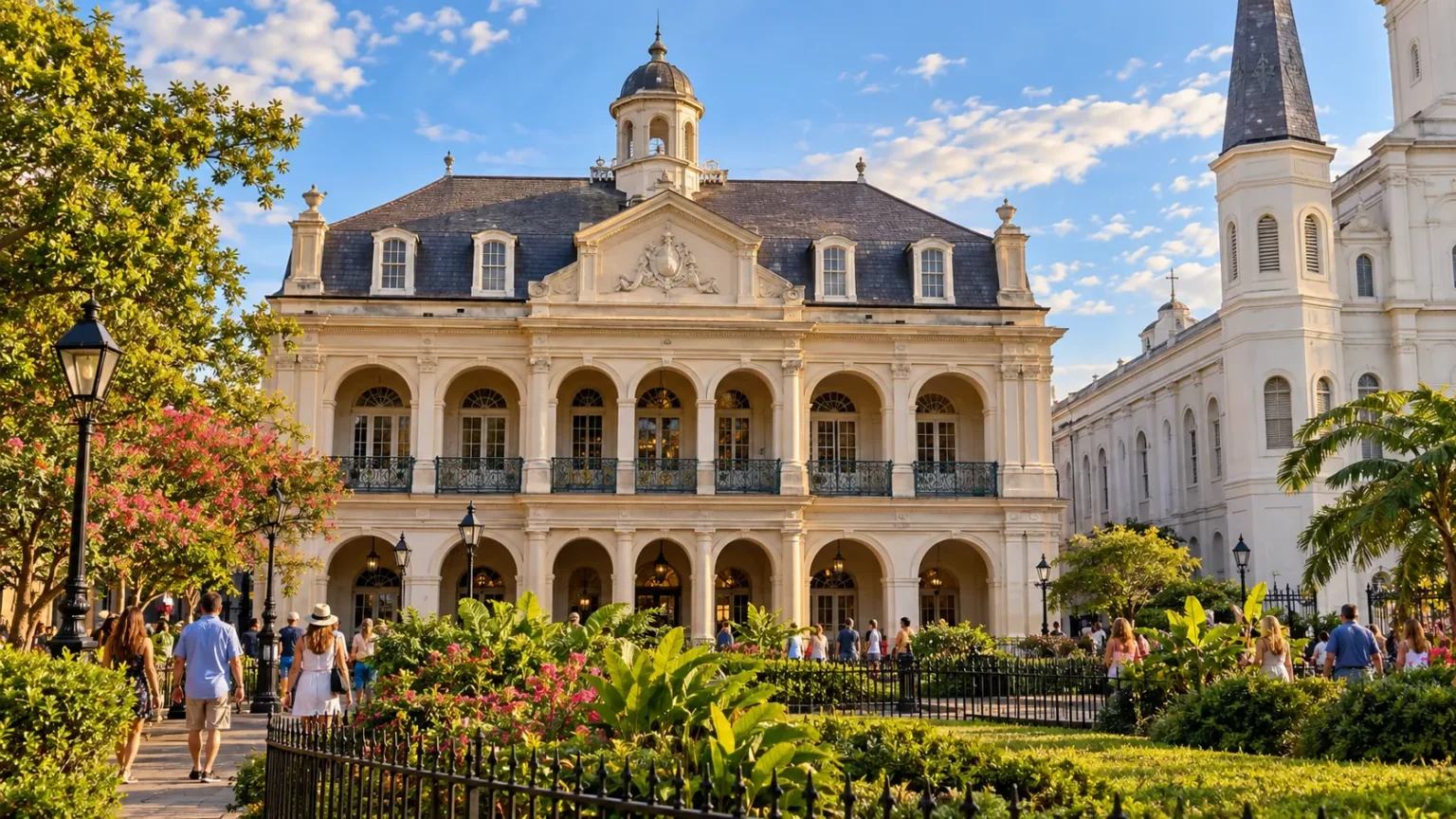
The Cabildo’s address is 701 Chartres Street, directly beside St. Louis Cathedral in the French Quarter. If you face the cathedral from Jackson Square, the Cabildo is the substantial historic building on your left. The similar-looking Presbytère stands on the other side, so check the entrance signs rather than assuming both buildings contain the same museum.
Before entering, spend a few minutes understanding the arrangement of the square and its surrounding landmarks. Notice how the cathedral and neighboring buildings create the recognizable backdrop seen in many New Orleans photographs. This short pause helps you connect the museum’s subject matter with the physical setting instead of treating the visit as an isolated indoor attraction.
If you are staying nearby, walking may be the simplest way to reach the museum without arranging parking. Travelers arriving from farther away should plan their transport around their accommodation and the wider day’s activities. Leave some extra time for busy sidewalks, street crossings, and the temptation to stop along the way.
Admire the Building Before Exploring the Exhibits
The Cabildo’s exterior deserves attention before you begin reading exhibition labels inside. Look at the rhythm of the arches, the proportions of the façade, and its relationship with the cathedral next door. Photographing these details can be more satisfying than taking only a wide shot, particularly when crowds make an unobstructed view difficult.
Remember that the building you see reflects construction, adaptation, damage, and restoration over time. Historic architecture is rarely a completely untouched survival from its first years, especially in a city with a complicated past. Watching for differences in materials and design encourages a more thoughtful visit than simply searching for a perfect colonial-era image.
Inside, balance attention to the exhibitions with awareness of the rooms themselves. Consider how a public building might have accommodated officials, visitors, legal proceedings, and the movement of people through its spaces. You do not need architectural expertise to enjoy this exercise; it simply helps you notice that the structure is part of the museum experience.
Explore People and Power at the Cabildo
People and Power: Building History at the Cabildo is especially relevant because it explores the building’s own legacy. The exhibition examines people, politics, and institutions associated with the site, including policing and imprisonment. It also considers how those activities reflected and reinforced racial and social hierarchies, giving visitors reasons to look beyond the attractive exterior.
Give this exhibition time if you want to understand how government buildings affect everyday lives. Ask who had authority, who could participate, and whose experiences were limited by the institutions operating here. Those questions make the visit more meaningful because they connect a familiar landmark with the less visible relationships that shaped its history.
Rather than trying to remember every name and date, choose two or three ideas that change your understanding of the building. You might focus on how its function evolved or how different groups experienced public power. This approach works particularly well for visitors who enjoy historical interpretation but become tired when attempting to read every label.
Discover Louisiana’s Role in the American Revolution
Gálvez and Louisiana in the American Revolution explores Spanish Governor Bernardo de Gálvez and Louisiana’s contribution to American independence. The exhibition broadens the story beyond the locations and figures that dominate many introductions to the Revolution. It emphasizes the diverse people involved, making it a useful stop for travelers interested in Louisiana’s international connections.
As you explore, pay attention to geography as well as personalities because routes, waterways, and regional alliances help explain the events. Consider why developments around Louisiana mattered to a conflict taking place across a much larger area. This gives the exhibition a clearer narrative and helps prevent unfamiliar names from becoming a disconnected list.
The museum’s exhibition calendar currently schedules this display through May 15, 2027, although travelers should confirm availability before visiting. Temporary exhibitions can influence how you allocate time, especially if one closely matches your interests. If your trip falls outside its run, ask which displays offer a similar perspective on Louisiana’s colonial and military history.
Learn About the Battle of New Orleans
The Battle of New Orleans exhibition offers another opportunity to examine Louisiana’s place in a wider historical story. Its interpretation includes the battle’s participants and the ways the event has been remembered and represented afterward. This combination encourages visitors to think about both the historical conflict and the public memory built around it.
Look closely at how images, objects, and explanatory text work together rather than moving quickly between recognizable names. A dramatic depiction may emphasize one part of the story while leaving other participants less visible. Comparing the display elements can help you understand how museums use evidence to explain events that later became powerful cultural symbols.
The Cabildo provides interpretation of the battle, but visiting its exhibition is not the same as visiting the battlefield itself. If military history is a major interest, you may want to plan a separate outing after researching the relevant site. For a shorter New Orleans trip, the museum can provide useful context without requiring another journey.
Look for Notable Objects and Changing Exhibitions
Napoleon’s death mask is among the Cabildo’s best-known collection highlights and can be a memorable focal point during your visit. The museum also features historical objects, documents, and artwork that reward closer attention. Ask staff whether a particular item you hope to see is currently displayed, since collection highlights and gallery arrangements can change.
Bienvenue Lafayette is another exhibition to consider when available, examining Lafayette’s connection with Louisiana and his celebrated 1825 visit. It is currently scheduled through May 4, 2027. Its focus on a visiting public figure provides a different angle from the building’s institutional history and the military stories explored elsewhere in the museum.
Choose your route according to your interests rather than assuming every visitor should spend equal time in every gallery. Someone drawn to art may linger over paintings, while another traveler may prioritize documents and political history. Checking the current exhibition lineup before arrival helps you make those choices without turning the visit into a rigid checklist.
Check Opening Hours, Tickets, and Accessibility
As checked in October 2026, the Cabildo lists opening hours of 9:00 a.m. to 4:00 p.m., with the last ticket sale at 3:30 p.m. It also notes selected holiday closures and Monday closures during summer. Older travel listings may show a different weekly schedule, so confirm the arrangements for your actual travel date.
Current listed admission is $15 for adults and $13 for Louisiana residents, with free entry for children aged six and under. Discounts are available for several eligible groups, and simultaneous purchases for multiple state museums may qualify for a reduction. Confirm eligibility and purchasing conditions before assuming a discount applies, particularly when booking several attractions.
The museum lists wheelchair accessibility and elevator access to each floor, along with text guides available on request in several languages. Contact staff before visiting if you have specific access requirements or need assistance planning the route. Advance questions can help you understand practical details that a general accessibility description may not fully address.
Combine Your Visit With Nearby Historic Attractions
Jackson Square and St. Louis Cathedral are natural companions to a Cabildo visit because they are immediately nearby. Spend time outside after the galleries to reconnect the historical interpretation with the neighborhood. If you enter the cathedral, respect services and visitor instructions, treating it as an active place of worship rather than simply another photographic backdrop.
The Presbytère is a separate museum, known for exhibitions about Mardi Gras and hurricanes, including Hurricane Katrina. However, its current notice states that it is closed for building upgrades through October 14, 2026. Travelers visiting around that period should confirm reopening arrangements before adding it as a guaranteed indoor stop or purchasing a combined itinerary.
Other French Quarter options include the 1850 House, the Historic New Orleans Collection, and a walk along Royal Street. Choose one additional museum or a relaxed neighborhood stroll depending on your energy and interests. Keeping the plan manageable gives you time to absorb what you have seen instead of collecting entrances without enjoying the visits.
Add a Food Break and a French Quarter Walk
A meal or coffee break helps turn the museum visit into a comfortable outing rather than an uninterrupted stretch of sightseeing. The surrounding French Quarter offers opportunities to explore local food, with beignets among the familiar choices. Select a stop based on your appetite, budget, and available time rather than feeling obliged to queue for every famous name.
Keep food and drink breaks outside the gallery experience unless staff identify an appropriate permitted area. A proper pause also helps if your group includes people with different levels of interest in reading displays. Discussing one memorable object over lunch can be more enjoyable than asking everyone to maintain the same pace throughout the museum.
Afterward, walk toward the riverfront or explore nearby streets if the weather and your energy allow it. Notice storefronts, balconies, courtyards visible from public areas, and the changing activity around the square. These observations complement the museum by reminding you that the French Quarter is a living neighborhood as well as a historic destination.
Choose a Comfortable Time and Pace for Your Visit
A morning visit can work well when you want to begin with the museum before deciding how much walking to do afterward. It also gives you more flexibility than arriving close to the final ticket sale. Crowds vary with events and travel periods, so treat timing as a planning choice rather than a promise of quiet galleries.
Warm weather, rain, and fatigue can affect the outdoor part of your day even when the museum remains comfortable to explore. Carry water for permitted outdoor use, wear footwear suitable for walking, and leave room for breaks. Check local weather before departing, then adjust the route instead of forcing a long walking itinerary around fixed reservations.
For families, choose a few objects or questions to focus on rather than expecting children to read every panel. Ask whether current educational materials or activities are available, and let curiosity guide the pace. A shorter visit with genuine engagement can be more successful than completing every room after the group has become tired.
Build a Simple Half-Day Cabildo Itinerary
Begin with a short walk around Jackson Square to identify the Cabildo, cathedral, and surrounding buildings before entering the museum. Spend approximately ninety minutes exploring the exhibitions that interest you most, allowing longer if you enjoy detailed reading. This is a suggested allocation, not a required visit length or an estimate of how every traveler will experience the galleries.
Follow the museum with a relaxed food break, then choose one nearby activity instead of several competing stops. You might visit another open museum, respectfully explore the cathedral when available, or continue along Royal Street. This structure keeps the day flexible enough to accommodate queues, weather changes, and the interests of different people in your group.
If you have only an hour, prioritize a small number of galleries and accept that you will not see everything. If you have most of the day, add another attraction after checking its hours and admission arrangements separately. The Cabildo works best as an anchor for an enjoyable neighborhood visit rather than a reason to overfill the schedule.
Conclusion
The Cabildo is worth considering when you want to understand the history behind one of New Orleans’ most recognizable settings. Its architecture, government history, and exhibitions provide several ways into Louisiana’s past. A visit is especially rewarding when you look beyond famous events and spend time considering the people and institutions associated with the building.
Plan around the exhibitions that interest you, confirm current visitor arrangements, and leave enough time to explore without rushing. Nearby landmarks make it easy to extend the outing, but separate opening hours and temporary closures still matter. A flexible half-day plan generally offers more room for meaningful discoveries than a tightly packed list of museums.
Combine the galleries with time around Jackson Square, a food break, and a comfortable French Quarter walk. That balance connects historical learning with the atmosphere that draws travelers to New Orleans. Whether you stay for a focused hour or read more extensively, the Cabildo can add depth to your understanding of the city.
FAQs
What Is the Cabildo in New Orleans Famous For?
The Cabildo is known for hosting Louisiana Purchase transfer ceremonies in 1803. It is also a historic government building and museum, with exhibitions exploring Louisiana’s history, political institutions, and cultural connections.
How Long Should I Spend at the Cabildo?
Allow roughly ninety minutes to two hours as a planning estimate. A focused visit may be shorter, while travelers who enjoy reading exhibition labels and examining objects closely may want additional time.
Where Is the Cabildo Located?
The Cabildo is at 701 Chartres Street beside St. Louis Cathedral on Jackson Square. When facing the cathedral from the square, the Cabildo is the historic building on the left.
Are the Cabildo and the Presbytère the Same Museum?
No, they are separate Louisiana State Museum properties with different exhibitions. They stand on opposite sides of St. Louis Cathedral, and admission arrangements and temporary closures should be checked separately.
Is the Cabildo Suitable for Children?
Yes, especially when the visit focuses on a few interesting objects and accessible questions. Choose a manageable pace, ask about available educational activities, and combine the galleries with an outdoor or food break.