





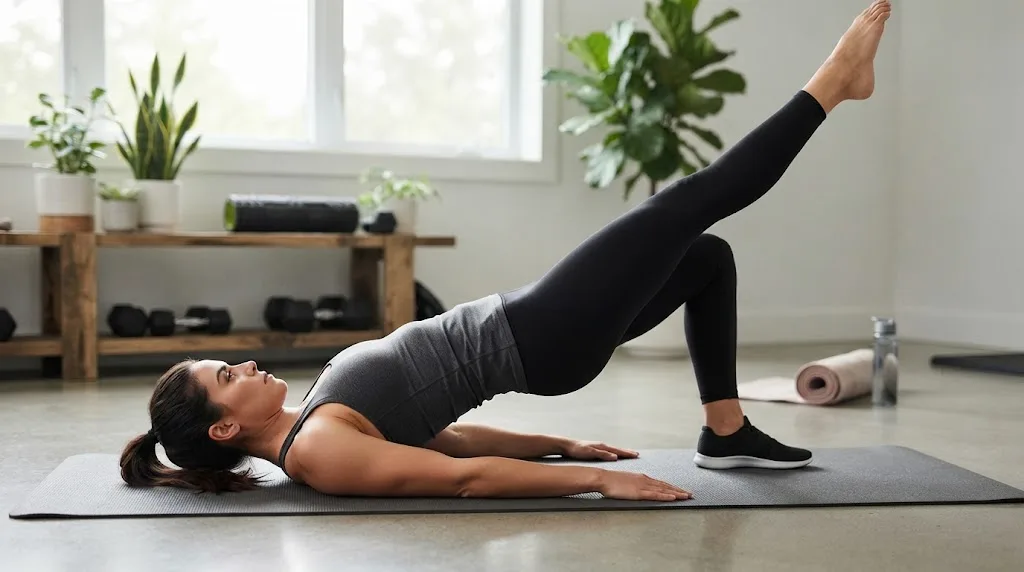
The single leg glute bridge is a simple bodyweight exercise that strengthens the glutes, hamstrings, hips, and core without requiring gym equipment. It builds on the standard glute bridge by asking one side of your body to work independently. This makes the movement especially useful for improving unilateral strength, hip stability, and control.
Because only one foot remains on the floor, the exercise becomes much more challenging than it looks. Your working glute must produce force while your core keeps the pelvis from rotating or dropping. When performed correctly, the single leg glute bridge can help improve lower-body strength and support better movement during walking, running, lifting, and sports.
Good technique matters more than lifting your hips as high as possible. Excessive back arching, poor foot placement, or pushing through the toes can reduce glute involvement and create unnecessary discomfort. This guide explains the benefits, correct form, common mistakes, progressions, and best practices for getting more from the single leg glute bridge.
What Is a Single Leg Glute Bridge?
A single leg glute bridge is a hip-extension exercise performed while lying on your back with one foot planted on the floor and the opposite leg lifted. From this position, you drive your hips upward using the glute and hamstring of the working leg. The movement trains one side at a time instead of allowing both legs to share the load.
The exercise primarily targets the gluteus maximus, which is the large muscle responsible for extending the hip. Your hamstrings also contribute, while the gluteus medius and core muscles help control pelvic position. Because one leg is unsupported, your body must resist rotation and maintain stability throughout the repetition.
Single-leg training can reveal differences between the left and right sides that are less obvious during bilateral exercises. One side may feel stronger, more stable, or easier to control than the other. Training each side separately gives you an opportunity to improve those differences gradually while developing better awareness of how your hips move.
Benefits of the Single Leg Glute Bridge
One major benefit is increased glute activation because each side must work independently. In a standard bridge, the stronger leg can sometimes contribute more without you noticing. The single leg version reduces that possibility and encourages the working hip to produce force while the opposite side remains controlled.
The exercise can also improve hip stability and pelvic control. These qualities are useful during movements where one leg supports most of your body weight, such as walking, running, climbing stairs, or changing direction. Better control around the hips can make these activities feel more efficient and help your lower body handle movement more confidently.
Another advantage is convenience. The exercise requires no machine, barbell, or large training space, making it suitable for home workouts, warm-ups, and travel routines. It can also be included in strength sessions alongside squats, deadlifts, lunges, and hamstring exercises to create a more balanced lower-body training program.
How to Do a Single Leg Glute Bridge Correctly
Lie on your back with one knee bent and the foot of that leg planted firmly on the floor. Keep the other leg lifted, either with the knee bent or extended depending on your comfort. Place your arms beside your body, gently brace your core, and keep your ribs from flaring upward.
Press through the planted foot and squeeze the glute as you lift your hips toward the ceiling. Raise only as high as you can without excessively arching your lower back or twisting your pelvis. At the top, your shoulders, hips, and working knee should form a comfortable line while your pelvis remains level.
Pause briefly at the top, then lower your hips slowly instead of dropping back to the floor. Maintain control throughout the entire repetition and keep tension in the working glute. Complete your target repetitions on one side before switching legs, or alternate sides if that helps you maintain better form.
Best Foot Position for Better Glute Activation
Foot placement changes how the exercise feels. If your foot is too close to your hips, you may feel more effort around the knee or quadriceps. If it is too far away, the hamstrings may dominate and you may struggle to maintain a strong hip extension position.
A good starting point is placing the heel far enough from your hips that your shin is roughly vertical near the top of the bridge. This position often allows the glute and hamstring to share the work effectively. Small adjustments may still be necessary because body proportions and mobility vary between individuals.
Try pressing through the whole foot with an emphasis on the heel and midfoot rather than pushing only through the toes. Your foot should remain stable throughout the movement. If your heel keeps lifting or your knee moves excessively inward or outward, reduce the range and reset your position before continuing.
Common Single Leg Glute Bridge Mistakes
One common mistake is allowing the pelvis to rotate as the hips rise. The unsupported side may drop or twist because your core and hip stabilizers are not controlling the movement. Reduce the height if necessary and focus on keeping both hip bones facing upward rather than chasing maximum range.
Another mistake is arching the lower back instead of extending through the hip. When the glute stops contributing effectively, some people compensate by pushing their ribs upward and overextending the spine. Keep your abdomen lightly braced and think about bringing the hips upward through glute contraction rather than trying to force them as high as possible.
Rushing through repetitions also reduces exercise quality. Fast movements make it easier to use momentum and harder to notice whether your pelvis is shifting. Use a controlled tempo, pause briefly at the top, and lower slowly so the working muscles remain engaged during both the lifting and lowering phases.
How Many Reps and Sets Should You Do?
Beginners can start with two or three sets of 8 to 12 controlled repetitions per side. The exact number matters less than maintaining good technique from the first repetition to the last. Stop the set when your pelvis begins twisting, your back starts arching, or you can no longer feel the working glute contributing effectively.
More experienced exercisers can increase repetitions, add another set, or make the exercise harder through resistance. However, simply performing very high repetitions is not always the best progression. Once sets become easy, adding load or choosing a more demanding variation can provide a stronger training stimulus without making the workout unnecessarily long.
Training the movement two or three times per week can work well for many people, depending on the rest of their program. If you already perform heavy squats, deadlifts, lunges, or hip thrusts, you may need less additional bridge volume. Recovery and overall training balance should guide how often you include the exercise.
How to Progress the Single Leg Glute Bridge
The easiest way to progress is to increase control before adding resistance. Slow the lowering phase, pause longer at the top, or increase the number of clean repetitions. These changes make the exercise more demanding while reinforcing better positioning and helping you notice whether one side loses stability faster than the other.
You can also place a dumbbell, weight plate, or other suitable resistance across the working side of your hips. Hold it securely and continue using the same controlled bridge technique. Increase load gradually because adding too much resistance too quickly may encourage lower-back arching or cause you to lose the level pelvic position.
More advanced progressions include elevated single leg bridges, single leg hip thrusts, or versions performed with the foot on a bench. These movements increase range of motion and difficulty. Progress only after the floor version feels stable, because greater range does not provide much benefit if your technique becomes less controlled.
Single Leg Glute Bridge for Home and Travel Workouts
The single leg glute bridge is particularly useful when you need an effective lower-body exercise without equipment. It can be performed in a bedroom, hotel room, living room, or small workout space. Pairing it with bodyweight squats, lunges, push-ups, and core exercises can create a simple full-body routine almost anywhere.
That portability also makes it useful for people who want to remain active while traveling. Whether you are exploring new cities or planning trips around affordable travel destinations, a bodyweight routine removes the need to find a gym. A few controlled sets can help you maintain training consistency without taking equipment in your luggage.
For a short travel workout, perform two or three rounds of single leg glute bridges, reverse lunges, bodyweight squats, and a plank variation. Keep the session simple and focus on quality rather than exhaustion. Even brief workouts can help maintain routine and movement when your normal training environment is unavailable.
How It Compares With Regular Glute Bridges
The regular glute bridge uses both legs and is generally easier to learn. It allows beginners to understand hip extension, glute engagement, and pelvic control without needing as much balance or unilateral stability. For many people, mastering the standard version is the best first step before progressing to single leg work.
The single leg version increases the relative load on each working hip without requiring external weight. It also exposes side-to-side differences more clearly and places greater demands on the core. This makes it useful when the standard bridge no longer feels challenging or when unilateral strength is an important part of your training goals.
Neither version is automatically better for everyone. Beginners may benefit from regular bridges, while stronger exercisers can use both versions for different purposes. A balanced program might include weighted bilateral hip thrusts for heavier strength work and single leg bridges for stability, control, warm-ups, or accessory training.
When to Avoid or Modify the Exercise
The single leg glute bridge should create muscular effort rather than sharp pain. If you experience significant discomfort in the lower back, hip, knee, or hamstring, stop and reassess your setup. Returning to a regular two-leg bridge may allow you to build strength and control before attempting the single-leg variation again.
Hamstring cramping is another common problem. Moving the working foot slightly closer to your hips may reduce hamstring dominance and help the glute contribute more. You can also rest between repetitions, reduce the bridge height, and make sure you are not aggressively pulling your heel toward your body during the movement.
Anyone recovering from recent hip, knee, back, or abdominal surgery or injury should follow appropriate professional guidance before adding new exercises. Persistent pain, weakness, or symptoms that interfere with normal walking and daily movement deserve proper assessment. Exercise selection should support recovery rather than becoming something you repeatedly force through discomfort.
Best Practices for Better Results
Focus on consistency rather than trying to make every workout extremely difficult. Performing the single leg glute bridge with good technique several times per week can be more productive than doing one exhausting session followed by poor recovery. Track your repetitions and resistance so you know when the movement is genuinely becoming easier.
Train both sides, but pay attention to meaningful differences. If one side feels less stable, begin with that side and match the same number of quality repetitions on the stronger leg. Avoid doubling the workload on the weaker side unless a qualified professional has specifically recommended that approach for your situation.
Finally, combine glute bridges with other movement patterns. Squats, lunges, deadlifts, step-ups, hamstring curls, and core exercises challenge the lower body in ways bridges cannot fully replace. The single leg glute bridge works best as one useful piece of a balanced program rather than as the only exercise for your glutes and hips.
Conclusion
The single leg glute bridge is an effective bodyweight exercise for strengthening the glutes, hamstrings, hips, and core while improving unilateral stability. Because each side works independently, the movement can expose strength differences and challenge pelvic control more than the standard two-leg bridge. It is also convenient enough to perform almost anywhere without gym equipment.
Proper form should remain the priority. Keep the pelvis level, brace your core, press through a stable foot, and lift through the hip instead of arching your lower back. Controlled repetitions and gradual progression provide more value than chasing maximum height, speed, or extremely high repetition counts.
Use the exercise as part of a broader lower-body program that includes several movement patterns. Progress by increasing control, repetitions, resistance, or range only when your technique remains solid. With consistent practice, the single leg glute bridge can become a practical tool for building stronger hips, better stability, and more balanced lower-body strength.
FAQs
What muscles does the single leg glute bridge work?
The exercise primarily targets the gluteus maximus and hamstrings. Your core and smaller hip stabilizers also work to keep the pelvis level and prevent rotation during each repetition.
Is the single leg glute bridge good for beginners?
Beginners can use it after learning the regular glute bridge with good control. If the single-leg version causes twisting, cramping, or back arching, return to the easier bilateral variation first.
How many single leg glute bridges should I do?
Start with two or three sets of 8 to 12 controlled repetitions on each side. Increase repetitions or resistance gradually once you can maintain consistent form throughout every set.
Why do I feel single leg bridges in my hamstrings?
Your foot may be too far from your hips, or your glutes may not be contributing efficiently. Adjust foot placement, reduce the range, and focus on squeezing the working glute during the lift.
Can single leg glute bridges build bigger glutes?
They can contribute to glute growth when they provide enough resistance and are progressively overloaded. For greater muscle development, combine them with other glute exercises, adequate nutrition, and consistent strength training.