




Bolivia is one of South America’s most distinctive destinations, combining high-altitude cities, enormous salt flats, ancient archaeological sites, colonial architecture, mountains, lakes, and Amazonian landscapes. Travelers can move from busy markets in La Paz to seemingly endless white horizons in Uyuni within the same trip, making the country especially rewarding for adventurous visitors.
A Bolivia travel guide needs to go beyond one famous attraction. Salar de Uyuni may receive much of the attention, but places such as Lake Titicaca, Sucre, Potosí, Tiwanaku, and the Amazon region offer very different experiences. Bolivia also has seven properties on UNESCO’s World Heritage List, reflecting the country’s cultural and natural diversity.
Travel here can require more planning than visiting a compact resort destination. High altitude, long distances, changing weather, and remote attractions all affect itineraries. With enough time and a flexible approach, however, Bolivia can deliver an impressive combination of landscapes, history, culture, wildlife, and outdoor adventure.
Why Visit Bolivia?
Bolivia appeals to travelers who want dramatic scenery and experiences that feel different from conventional city breaks. The landscape ranges from the high Andean Altiplano to salt flats, volcanic terrain, deep valleys, tropical lowlands, and rainforest. This geographic variety means a single itinerary can include completely different climates and environments.
Culture is equally important to the experience. Indigenous traditions remain highly visible in clothing, food, markets, festivals, languages, crafts, and everyday life throughout many parts of the country. Historic centers and archaeological sites add another layer, allowing travelers to experience both pre-Hispanic heritage and architecture that developed during the colonial period.
Bolivia can also reward travelers who enjoy slower, experience-focused journeys. Rather than racing between attractions, allow time to explore markets, walk through historic neighborhoods, adjust to altitude, and talk with local guides. The country’s strongest experiences often come from combining major landmarks with ordinary streets, regional food, traditional communities, and scenic journeys between destinations.
Explore the Incredible Salar de Uyuni
Salar de Uyuni is the attraction most travelers immediately associate with Bolivia. Covering roughly 10,500 square kilometers, it is widely recognized as the world’s largest salt flat and sits more than 3,600 meters above sea level. Its vast white surface creates an almost unreal landscape that changes dramatically with weather and seasonal conditions.
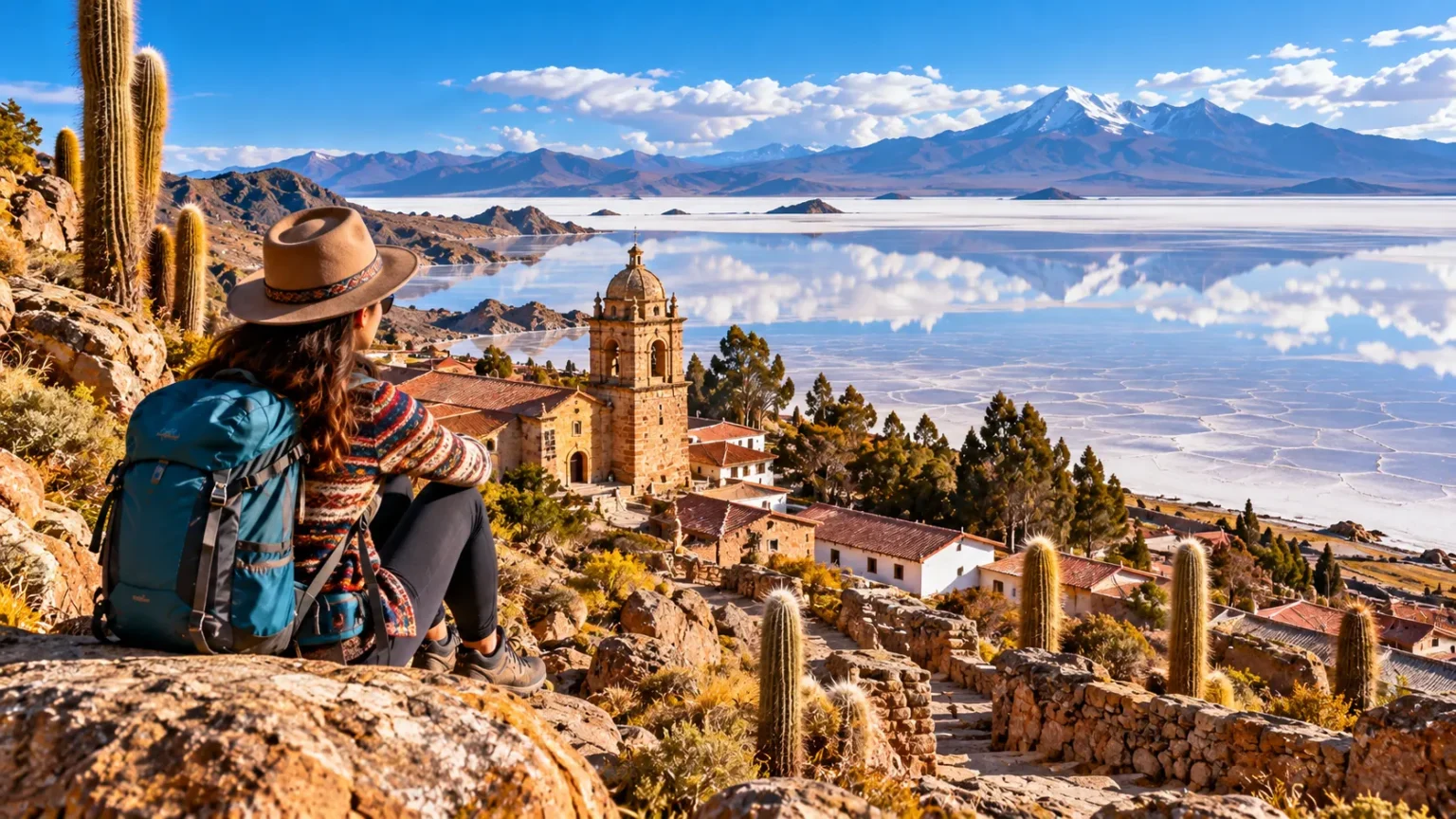
During drier conditions, geometric salt patterns stretch toward the horizon and create excellent opportunities for perspective photography. During parts of the wet season, a shallow layer of water can transform the surface into a giant natural mirror. The famous reflection effect is generally associated with wetter months, although exact conditions vary from year to year.
Most visitors reach the salt flat from the town of Uyuni and explore by 4×4. One-day trips focus mainly on the Salar, while longer journeys can continue toward colorful lagoons, geothermal areas, desert landscapes, and high-altitude scenery. Because conditions can be remote and demanding, choosing an experienced operator and carrying appropriate clothing are sensible priorities.
Discover La Paz From Streets to Cable Cars
La Paz offers one of the most memorable urban landscapes in South America. Buildings spread across steep slopes beneath dramatic mountains, while busy streets combine traditional markets with restaurants, government buildings, modern businesses, and residential neighborhoods. Simply exploring different elevations gives visitors constantly changing views of the surrounding city and Andean geography.
One of the easiest ways to appreciate the scale of La Paz is to travel on its cable-car network. The elevated routes provide broad city views while connecting different neighborhoods and nearby El Alto. Markets and central districts are also worth exploring on foot, although the altitude and steep streets encourage visitors to move more slowly than they might expect.
Give yourself time to adjust after arriving, particularly if you have traveled directly from a much lower elevation. Plan gentle sightseeing at first, drink fluids regularly, and avoid scheduling demanding physical activities immediately. Once comfortable, La Paz makes a useful base for exploring nearby attractions such as Tiwanaku and the Lake Titicaca region.
Experience Lake Titicaca and Isla del Sol
Lake Titicaca sits along the border between Bolivia and Peru and forms one of the most striking landscapes of the Andean Altiplano. On the Bolivian side, Copacabana is the main traveler hub and departure point for boat trips. The deep-blue water surrounded by high mountains makes the area visually different from almost every other stop in Bolivia.
Isla del Sol is one of the best-known destinations on the lake. Travelers visit for walking routes, small communities, viewpoints, archaeological connections, and wide-open views across the water. Boats operate from Copacabana, though schedules and access to parts of the island can change, so checking locally before departure is sensible.
Spending a night near the lake can create a more relaxed experience than rushing through on a day trip. Sunrise and sunset are particularly beautiful when conditions are clear, and slower travel gives your body more time to handle the altitude. Comfortable footwear is important because even short walks can feel demanding at elevations above 3,800 meters.
Walk Through the Historic Streets of Sucre
Sucre provides a slower and more elegant contrast to La Paz. Whitewashed buildings, courtyards, churches, plazas, and historic streets give the center a distinctive appearance, while cafés and museums make it easy to spend several relaxed days exploring on foot. The city’s historic center is recognized by UNESCO for its architectural and cultural significance.
The city developed as an important administrative, religious, and cultural center during the colonial period. UNESCO highlights Sucre’s well-preserved religious buildings and the way its architecture blends local traditions with styles introduced from Europe. Exploring the historic center therefore offers more than attractive photographs; it provides insight into important layers of Bolivia’s history.
Sucre also works well as a place to slow down between more demanding destinations. Travelers can spend mornings visiting museums and markets, enjoy long lunches, and walk to viewpoints in the afternoon. Its comparatively relaxed atmosphere makes it especially appealing after long journeys through the Altiplano or before continuing toward Potosí and Uyuni.
Discover the Mining History of Potosí
Potosí is another important historic destination and has been listed as a UNESCO World Heritage property since 1987. The city grew around the enormous mineral wealth associated with Cerro Rico, whose silver played a major role in the colonial economy. Today, the mountain remains a defining visual and historical presence above the city.
Walking around central Potosí reveals churches, narrow streets, historic buildings, plazas, and reminders of the city’s mining legacy. Museums can provide valuable context before visiting sites connected with mining history. Understanding the human cost associated with historic silver production is important, because Potosí’s heritage includes difficult stories as well as remarkable architecture and economic significance.
Some travelers consider mine tours, but these experiences deserve careful thought because conditions can be physically demanding and ethically complex. If you choose one, research operators closely and understand what the visit involves. Even without entering a working mine, Potosí offers enough history and architecture to justify a stop between Sucre and the Uyuni region.
Visit the Ancient Ruins of Tiwanaku
Tiwanaku is one of Bolivia’s most significant archaeological destinations and can be visited from La Paz. Located on the Altiplano near Lake Titicaca, the site preserves monumental remains associated with a major pre-Hispanic civilization. UNESCO describes Tiwanaku as the spiritual and political center of a culture that exercised wide influence across the southern Andes.
The settlement developed over many centuries and reached a major period of importance between roughly AD 500 and 900. Surviving ceremonial structures and stonework provide insight into engineering, architecture, belief systems, and political organization long before Spanish colonization. Visiting with a knowledgeable guide can make features that initially appear abstract much easier to understand.
Tiwanaku works particularly well as a day trip for travelers interested in archaeology and Andean history. Give yourself enough time to see both the outdoor remains and available museum displays rather than treating the site as a quick photo stop. Combining Tiwanaku with broader reading about Andean civilizations can make the experience significantly more meaningful.
Experience Bolivia’s Amazon Region
Bolivia is not only mountains and high-altitude desert. Traveling toward the northern lowlands reveals tropical forests, rivers, wetlands, and a completely different climate. Rurrenabaque is commonly used as a gateway for travelers interested in Amazonian rainforest experiences and wildlife-focused excursions in surrounding protected landscapes.
Trips in the region may involve boat travel, forest walks, wildlife observation, and stays in lodges or basic accommodation. Depending on the route, travelers may encounter monkeys, birds, reptiles, river wildlife, and an enormous variety of plant life. Wildlife sightings are never guaranteed, which is part of what makes genuine nature experiences different from visiting controlled attractions.
Choose operators that emphasize responsible wildlife viewing and respect protected environments. Avoid tours that encourage handling wild animals or disrupting natural behavior purely for photographs. Lightweight clothing, rain protection, insect protection, sturdy footwear, and patience are valuable, especially when tropical weather changes quickly or travel involves muddy trails and river transport.
Add Outdoor Adventure to Your Bolivia Trip
Bolivia offers many opportunities for travelers who want active experiences rather than conventional sightseeing. Hiking, mountain biking, climbing, trekking, and high-altitude excursions are available in several regions. The Andes provide particularly dramatic environments, but altitude can make activities considerably harder than similar routes closer to sea level.
Experienced hikers may look toward mountainous areas around La Paz or national parks such as Sajama, while other travelers may prefer gentler walks around lakes and valleys. Bolivia’s landscapes reward people who enjoy open spaces and remote scenery. However, conditions can change quickly, making local information, suitable clothing, navigation, and realistic fitness expectations important.
Avoid building an itinerary where every day involves demanding physical activity. Long road journeys, altitude, early departures, and cold nights can create fatigue even without hiking. Alternating active days with relaxed sightseeing gives you more time to recover and often results in a more enjoyable trip than trying to fit every adventure into a short schedule.
Enjoy Bolivian Food, Markets, and Local Culture
Food is an important part of traveling through Bolivia because regional dishes reflect differences in altitude, agriculture, and local traditions. Markets and neighborhood restaurants can introduce travelers to soups, potatoes, corn, quinoa, meat dishes, pastries, and fresh fruit. Trying local specialties is often one of the easiest ways to experience a destination beyond its headline attractions.
Salteñas are among the foods many visitors encounter early in their trip. These baked pastries contain savory fillings and are commonly eaten as a snack or morning food. Other dishes vary by region, so asking local residents or restaurant staff what is typical in each city can lead to more interesting choices than ordering the same meal everywhere.
Markets are also valuable cultural spaces rather than simply shopping stops. Take time to observe local produce, textiles, crafts, everyday products, and the pace of daily commerce. When photographing people, especially in traditional communities, ask permission rather than assuming that colorful clothing or a busy market automatically makes someone an appropriate subject for a photograph.
Best Time to Visit Bolivia and Essential Travel Tips
The best time to visit depends on what you want to experience because Bolivia’s landscapes vary widely. Drier months are often favored for clearer roads and outdoor activities in the highlands, while wetter periods can create the celebrated mirror effect at Salar de Uyuni. Rainfall, temperatures, and accessibility differ considerably between regions.
Altitude should be part of your itinerary planning rather than an afterthought. La Paz, Uyuni, Lake Titicaca, Potosí, and Tiwanaku are all high-elevation destinations, and some travelers need time to adjust. Start gently, stay hydrated, avoid overexertion soon after arrival, and seek medical help if altitude-related symptoms become severe or continue worsening.
Allow extra time for transportation as well. Bolivia’s mountain geography and long distances mean journeys can take longer than they appear on a map, while weather or road conditions may occasionally affect plans. A flexible itinerary with a few buffer periods is usually more enjoyable than a tightly scheduled trip where a single delay disrupts several reservations.
Conclusion
Bolivia rewards travelers with an unusual concentration of natural beauty, cultural heritage, historic cities, and adventurous landscapes. Salar de Uyuni may be the country’s most recognizable attraction, but La Paz, Lake Titicaca, Sucre, Potosí, Tiwanaku, and the Amazon lowlands each add something completely different to the experience.
A strong Bolivia itinerary combines major sights with enough time to adjust to altitude and appreciate everyday life. Instead of treating the country as a quick stop between neighboring destinations, consider spending additional days exploring different regions. Slower travel makes demanding journeys easier and creates more opportunities to discover local food, culture, landscapes, and history.
Plan around the experiences that matter most to you, whether that means photographing the salt flats, walking through colonial streets, visiting archaeological ruins, exploring markets, or heading into tropical forests. With sensible preparation and flexibility, Bolivia can become one of the most varied and memorable destinations on a South American journey.
FAQs
How many days do you need in Bolivia?
Around 10 to 14 days gives many travelers enough time to combine La Paz, Uyuni, Sucre, and another destination. Two to three weeks allows a more relaxed itinerary including Lake Titicaca or the Amazon.
What is the most famous place to visit in Bolivia?
Salar de Uyuni is Bolivia’s most internationally recognized attraction. Its enormous salt surface, unusual perspective views, and seasonal mirror effect make it one of South America’s most distinctive natural destinations.
Is La Paz worth visiting?
Yes. La Paz offers dramatic city views, colorful markets, distinctive neighborhoods, cable-car journeys, and convenient access to nearby destinations such as Tiwanaku and Lake Titicaca.
When can you see the mirror effect at Salar de Uyuni?
The mirror effect generally occurs during the wetter season when a thin layer of water covers parts of the salt flat. Conditions vary, so the effect cannot be guaranteed for a particular date.
What should I pack for Bolivia?
Pack layers for changing temperatures, comfortable walking shoes, sun protection, rain protection when appropriate, and warmer clothing for high-altitude areas. Your exact packing list should reflect the season and regions on your itinerary.